Showing posts with label marvel comics. Show all posts

Thursday, May 13, 2010

Elektra Review


(As a manga otaku, not a comic otaku, I will strive to reflect on connections to the comic canon or lack thereof in the films I review, animated or live action. I owe that much to the real fans)

Elektra as a film is not a direct sequel to Daredevil, more of a spin off. Supposedly the film barely made enough in the box office to necessitate the sequel, but I do remember it coming out in theatres, though I didn’t get the DVD until probably a year after its release. It advertises itself as an action fantasy adventure, owing to Elektra’s more mystical background as an assassin/ninja. As usual with any adaptation, there are discrepancies with the canon, but I’ll get to that as we progress. So onto the even less popular Marvel Comics film, Elektra.

We’re told of an ancient war between Good and Evil (because capitalization makes things really important) that has been waged for millennia. The conflict can take place between countries or in the soul of an individual (hinting at Elektra no doubt). The narrator also mentions a special woman who is meant to be used as a weapon, called the Treasure. An unnamed man hides at an undisclosed location, trying to avoid Elektra, which he has managed to do for some time, even being protected by the Hand, the present manifestation of the Evil spoken of in the introduction, but Elektra still manages to defeat every bodyguard the man puts in front of her. Elektra’s new look is shown and she quickly kills her target. We shift to a meeting headed by Roshi, the leader of the Hand, where it’s mentioned that they are looking for the Treasure and trying to keep it out of their enemy’s hands. Kirigi, Roshi’s son, notes that he is better suited for the job, Roshi sending another man and urging Kirigi to be patient. Elektra is approached by her manager, McCabe, about a new job, which she notes is quite expensive and must be specifically for her, which McCabe confirms. She accepts and en route to the location, she flashbacks to her being resurrected by her previous master Stick, and her training in Kimagure, the art used by the Good to combat the Evil that is the Hand. Elektra is told she does not understand the way, but only pain and violence which was what led her there before and after her resurrection. Elektra has another flashback to training with her father as she swims following her OCD organization of the house (involving fruits and toiletries). She comes in and catches Abby, a girl who was stealing a necklace of Elektra’s, sending her off. She’s woken up by a nightmare about her mother’s death and after training for most of the morning, meets Abby’s father. Later, Abby comes to invite Elektra for Christmas dinner, Elektra reluctantly accepting. At dinner, Elektra notes Abby’s Indonesian warrior beads after becoming adjusted to what is no doubt something uncommon for her (socializing with people not related to business). She observes Abby and her father’s interaction, reflecting her commonality to Abby (both being motherless and Elektra in particular orphaned, though pressured by her father in training) and disappearing abruptly. The next morning, Elektra gets the information from her clients, indicating that she’s to kill Abby and her father, a shock that she doesn’t take very well, going against her duty for once and stopping herself from killing them just as she has a clear shot. After realizing she can’t do it, Elektra nearly leaves, turning back at the last moment and stopping two assassins from the Hand (who explode into green smoke; must be a Hand ninja thing, because that’s what they’re dressed like, stereotypical ninja). Kirigi and his other fellow “ninjas” Stone, Typhoid, Tattoo and Kinkou (Kinkou a random character not based on any Marvel character in the slightest, the others based off of Marvel or Elektra characters) are given the task to find the Treasure and if they succeed, Kirigi will lead the council in Roshi’s place. Elektra finds Stick at a pool hall (bringing Mark and Abby along to protect them), but Stick refuses to help them. Elektra says she can’t help them either, but goes against this to take Abby and Mark to a safe place. Tattoo’s bird tracks them, allowing the assassins to continue to hunt Abby and Mark for reasons still yet unknown. Elektra brings them to McCabe’s place to lay low for a while, Abby changing her appearance and bonding with Elektra a bit, while Mark and Elektra hit it off in a more romantic direction (not like one shouldn’t expect such a subplot in any such movie to draw in females, even though the film’s protagonist is a female). Kirigi’s group manages to find them thanks to Tattoo’s eagle and McCabe holds them off, to no avail, as Kirigi finds out where they’re headed already and then kills McCabe. Typhoid, Stone and Tattoo, along with Kinkou, chase the three, Stone and Kinkou eliminated. It’s shown that Abby can actually fight and Kirigi reveals that she is the Treasure they’re searching for, though what that is has not yet been revealed. Stick and some white ninjas save the group from Kirigi as they retreat, Elektra saved from Typhoid’s poisonous lesbian kiss by Stick. Abby is revealed to have been a prodigy, which is why the Hand wants her. And unless she stays with Stick and the Kimagure clan, she isn’t safe. Abby and Elektra train a bit and Elektra sees a bit of herself in Abby. She then calls a single battle between her and Kirigi, going back to her family’s house to finish their conflict once and for all. The fight goes badly for Elektra until Abby comes in. The two escape and after being chased by Tattoo’s snakes, Elektra manages to kill him as he’s in the trance summoning them. Abby is caught off guard by Typhoid who poisons her, while Elektra finally gains the edge against Kirigi and slays him, quickly killing Typhoid afterwards. She then finds Abby, on the brink of death, but after a sudden enlightenment, she gains a new perspective on things and manages to revive Abby. Abby and her dad leave, while Elektra is inspired to pursue her new perspective on life by Stick, leaving her house as the film ends.

Jennifer Garner does Elektra very well, just as she did in Daredevil. Her personality this time was changed drastically, less sassy and more emotionless, cynical at best (since she died and came back to life and all, I’d bet she’s kind of moody). Her background is extended further as well, but still portraying a ninja assassin in red clothes excellently. Terence Stamp as Stick is good as well even if he is minor in his involvement. His role as a master to Elektra is crucial to really understanding the position Elektra came from and why she has to suffer in order to learn from her mistakes and redeem herself as a person. Kirsten Prout portrays Abby Miller, starting off as a teenager with authority issues and advancing into something of a mini clone of Elektra, though much more outgoing and suffering less than Elektra has in her short 13 years so far. Even losing her mother and being pressured as a prodigy is not nearly as much as Elektra has gone through and she makes you hope that she won’t go through so much in the future. Will Yun Lee is Kirigi, the one villain I found to be compellingly evil and someone that you can see virtue in with his respect for the divisions between the Hand and Kimagure as well as his slow and methodical way of fighting through the film. His ambition to control the Hand is admirable as well, albeit one might think he would’ve been willing to kill Roshi, but his father’s role was minor and actually unresolved as to what his fate was, though perhaps Roshi expected Kirigi to fail since he was not taking his advice to be patient. The other enemy ninjas are interesting as side characters, as is McCabe, all dying relatively uneventfully. Kirigi is not the last to die, Typhoid dying last probably since she said she was originally the Treasure, not revealed beforehand or even indicated. The flatness of these minor characters is a flaw the film suffers from in leaving so many plotlines unresolved or not delved into enough, such as Roshi’s fate and why Typhoid was originally the Treasure and not Kirigi, which would reinforce his desire to take her as his student. Daredevil is only referenced in the Director’s Cut in a single scene, when his background with Elektra might’ve served a useful role in the narrative.

The primary theme is the battle between good and evil (on the various levels: Hand v. Kimagure and Elektra’s internal struggle esp.) and how Elektra demonstrates that even the truly good must sometimes resort to violence to combat the truly evil. Elektra advances as a character, understanding herself and that her true nature is not evil or cold hearted, but feels and suffers and can therefore recover. Her recovery takes place through the film, connecting with Abby and her father and even reconnecting with Stick through his sagely, albeit vague, advice. There is also the relationship between Elektra and Abby in particular, both being pressured in some sense to face a destiny that they don’t want. Elektra was shown to have been trained by her father harshly (though in Daredevil she said it was the various sensei that made her strong, so already the continuity of the films is ruined) and Abby is a natural prodigy, possessing enough potential to be hunted down by the Hand and also pressured into staying with the Kimagure to stay safe, even though she herself doesn’t want this life. Her eventual resurrection by Elektra mirrors Elektra’s shown through flashbacks. Both of these revivals serve as focal points for the characters to pursue a new path and improve themselves. Elektra’s path took much longer, though she worries for Abby as well, but there is also the possibility that since Elektra influenced her, Abby may turn out even better.

The film progresses at a decent pace, but the action is less exciting than I recall. The fights against the two assassins are either nonexistent or Elektra dodging darts. And concerning Kirigi’s thugs, Stone is killed by the tree he knocked down, Kinkou by his own knife, Tattoo by his neck being broken as he sits in a trance, Kirigi by getting stabbed in the gut by Elektra as he rushes at her and Typhoid by a carefully thrown sai. The fight scenes seem to rely too much on the special effects and less on real choreography for hand to hand or even weapon to weapon combat. Kirigi in particular is an example of a failure on both parts, the weapon fighting scenes too short for what they could be and the use of the illusion of the flying tablecloths also ruining what could’ve been a good fight, now more visually confusing than necessary (his super speed effect already a challenge to Elektra). The progression of Elektra’s personality and relationships with Abby and Stick I can view as necessary (along with the general build up to the epic final battle between the representatives of the Hand and Kimagure), but for all the fight scenes promised, the film disappoints heavily. Even Daredevil had more in depth fight scenes than this and that had its own distracting problem with the romantic subplot which had some value regardless. This film would get one of my lowest ratings so far in hindsight after being so enthralled in it as a teen (possibly by the kunoichi appeal of Elektra and just seeing Jennifer Garner in a much more skimpy outfit). The star rating would be a 3 out of 5, due to the imbalance of a fair plot progression with a fantasy/ninja theme of good versus evil on the one hand and short lived or anticlimactic fight scenes and poor advancement of plotlines, such as the Treasure, etc, on the other. The recommendation would be around 50%, since it is some exposure to Elektra, even if they reversed at least one character’s role (Stone was originally a good guy in the comics) underpowered Kirigi as well (he could regenerate and was super strong, near invincible, in the comics) and even raped the continuity established in Elektra (since her father was not only changed to a direct training role, but the actor changed to a younger male, her father in Daredevil a white haired elderly man). I can’t take this movie as much more than pulling Elektra from Daredevil and trying to put her in a sequel film to cash in on her sex appeal and potential draw to female fans of comics, neither of which works especially well. It falls on both accounts: her sex appeal is subtle and not nearly what you’d expect even with her outfit redesigned, and her appeal to females hinges on her clairvoyant powers and also the use of what might be understood as a more female weapon in the sai, not to mention her physical toughness is less than expected. Disappointing on the one hand, but still possessing potential on the other. This could be extended into a television series and I would watch it, especially if you progressively introduced Elektra’s backstory as well as slowly intertwine her story with that of Abby’s as the Treasure, hunted by the Hand. All in all, this was a somewhat depressing but still heartening endeavor. Until next time, Namaste and Aloha.

Tuesday, May 11, 2010

Daredevil Review


(As a manga otaku, not a comic otaku, I will strive to reflect on connections to the comic canon or lack thereof in the films I review, animated or live action. I owe that much to the real fans)

Daredevil is my second favorite Marvel character besides the Punisher. The fact that he is a disabled character and yet able to fight off much stronger characters already makes him stand out; plus he’s one of the few noteworthy blind heroes that people can name from memory. It might be the costume that reminds you of a devil with the horns, it might be the weapon combat with billyclubs combined with the acrobatics that are less than believable with a blind character feeling it the whole way, but the character from Hell’s Kitchen in New York has persisted through the decades and this live action film attests to it (however much many may not enjoy it). I know I didn’t think much of it initially, seeing the ending fight between Daredevil and Kingpin and thinking it was cool, but not to the extent I’d want to buy the film. And about 4 years later, I watched the film and promised myself I’d review it soon in the future. So now I’ll make good on that promise.

The credits open with what are apparently Braille versions of the main four actors’ names, changing to regular characters, which is a nice start. We have a flash forward to events much later in the film with Daredevil falling into a church, bleeding profusely and being found by the priest there. He then begins to flash through his life, beginning as a child of a semi-retired boxer, Jack “the Devil” Murdock. Living in the slums of Hell’s Kitchen, Matt was bullied, but his father taught him that he can do anything if he’s not afraid. He finds his father beating a guy up for protection money, discovering he is working for Falen, a crime boss in the city. Running away, he is involved in an accident and is blinded by an unknown chemical. He wakes up with enhanced hearing to the point he has sonar like vision, his initial exposure showing his great weakness of sharp and sudden loud noises. He and his father then began to work towards their goals. His father gets back into boxing and Matt begins to self-train himself to adjust to his blindness with the aid of his “Daredevil vision”. Stan Lee makes a short appearance at 13 minutes in as the story progresses into Murdock Sr. being pressured to throw a fight, which he rejects. But afterwards, he is beaten to death by Falen’s goons, orphaning Matt, but pushing him to two goals: to become a lawyer to defend the less fortunate, but also becoming the crime-fighter alias, Daredevil. We shift to Matt as an adult, sleeping in a water coffin to guard against the sounds of the night, living cheaply and frugally as a lawyer. He fails to convict a man of rape, the guy getting off because of his status in contrast to the woman with a history of drug and alcohol abuse. His frustration is justified and he proceeds to take justice into his own hands later, Quesada (the man in question) falling onto the subway tracks and being summarily run over. An investigator into Daredevil’s urban legend, Ben Urich, reveals Daredevil’s interesting mark he leaves at the scenes of his “crimes”, overlapping D’s. Matt returns home to reveal his failing love life, which we’ll get into later. He goes to confessional, speaking to his priest about his being Daredevil, the priest reflecting that his path of violence is only going to hurt him in the end (also indicating he knows he is Daredevil). Matt and his partner Franklin run into an unknown woman whom Matt pursues. The two turn out to both be quite skilled fighters, Matt learning the woman’s name is Elektra Natchios. We shift to Kingpin, speaking with who appears to be Elektra’s father about business issues. Elektra and Matt hit it off after their fight and Kingpin sets a plan in motion to make Elektra’s father out to be the Kingpin. He also calls for the assassin Bullseye, an Irish expert in turning anything into a throwing weapon, including a paperclip and a peanut in two different situations. Meanwhile, Daredevil chases down another of Kingpin’s thugs, scaring the crap out of a kid in the process, Matt insisting he’s not the bad guy. The next day, Matt finds he’s been invited to a party at the hotel Elektra’s dad owns, but he insists he shouldn’t even bother going since she’s out of his league. He later meets Elektra and their relationship takes a turn for the better, no doubt motivating Matt to go to the ball. Though he is pressured by Elektra to stay with her even though the audience knows he hears a man being roughed up by Kingpin’s thugs elsewhere. At the party, Matt and his partner meet Wilson Fisk, the real Kingpin, but Matt’s adherence to his code of justice makes him something of an enemy already. Matt meets Elektra and the two speak on their relationship a bit, Elektra scared at how her meeting Matt seems too good to be true and Matt feeling bad that he can’t see Elektra all dressed up as she is. Bullseye obtains a motorcycle, while Kingpin puts a rose in Nikolaos Natchio’s breast pocket, indicating that he has been marked to be killed. He and Elektra leave Matt at the party. Bullseye finds the Natchios’ limo and takes out the drivers, fighting against Daredevil (missing for the first time) and then using Daredevil’s club to impale Elektra’s father, making Elektra think Daredevil murdered him as Bullseye gets away. Elektra meets Matt at the funeral and insists she must seek revenge, Matt pleading with her to stay with him and forget vengeance, which she rejects as she leaves. Ben Urich is shown that the Daredevil club recovered at the murder scene resembles Matt Murdock’s walking cane. Kingpin then sends Bullseye to kill Elektra, allowing him to kill Daredevil if he can as well. Ben Urich tells Matt that he thinks Natchios was set up by the real Kingpin, while elsewhere Elektra trains to kill Daredevil. Elektra ambushes Matt and eventually manages to overwhelm and injure him with one of her sai. After realizing she killed Matt, she is stunned. Then Bullseye shows up and begins to turn the tables, killing her with her own sai. Daredevil escapes and we shift to the scene from the opening as Bullseye bursts in to fight and kill Daredevil in the church. The two fight up the organ and into the upper belfry, where Bullseye uses stained glass shards as weapons after running out of his own supply. Daredevil is then disoriented by Bullseye striking one of the bells and causing other reverberations, also discovering that Fisk is the Kingpin but fate strikes as Bullseye’s hands are struck by a sniper’s bullet through Daredevil’s use of his radar vision, allowing Matt to knock him out of the top of the building onto a cop car. Elsewhere, Fisk tells his security to go home and prepares to fight Daredevil himself. Kingpin’s brutal style (created to take advantage of his size and strength) initially gives Matt a difficult time, but with creative use of the sprinkler system, he defeats Kingpin, disabling him by taking out his knees. Kingpin threatens to reveal his identity, but Daredevil retorts that he doubts he’d be bragging about getting beaten by a blind man. The next day, after leaving the coffee shop, Matt finds evidence that Elektra may still be alive. Also, Ben Urich reveals he knew Matt’s identity and leaves him to continue to protect the city, his alias safe.

Ben Affleck portrays Matt Murdock and Daredevil both very well. The attitude as a smooth talking lawyer raised in the slums is excellent and the Daredevil stunts, while not all done by a person (some in CG) are reminiscent of Spiderman’s moves. Jennifer Garner as Elektra is great as well, the depiction accessible to a non-comic audience with her attire adjusted, her personality and brutality from her training still maintained. Michael Clarke Duncan plays one of the two more controversial characters, Wilson Fisk/Kingpin. The original character is white and a bit more heavyset than Duncan, but I find that Duncan brings a good portrayal of what was his favorite character as a child. The important part of Kingpin is not his race so much as what he stands for, a heavyset businessman willing to go to blows to protect his reputation and economic status. Colin Farrell does Bullseye, another somewhat objectionable character in relation to comic canon. He had no Irish accent originally and the outfit was adjusted significantly, the bullseye on his forehead now an imprint/brand instead of part of his black full body suit from the comics. The insane demeanor and malice directed towards his targets is done just as well and I think that’s what’s important to his character. Joe Pantoliano does the minor character Ben Urich, who I feel has importance in a similar way that Detective Soap did to Frank Castle in Punisher Warzone, as a person who develops into a confidante for the character. Urich’s position as a reporter does differ from Soap’s, who is more in the police force than Urich, who is only indirectly involved, but he still stands out as a pseudo sidekick to the horned avenger.

One theme runs through the film: justice as blind and yet able to hear (as Matt puts it). The blindness of justice is reflected in Elektra’s character, that she seeks out revenge in a Punisher fashion and it gets her killed. The blindness of love is also part of this since Matt and Elektra would have been happy had the Kingpin and Bullseye not gotten involved. The whole tragedy of their romance is a subtheme in itself and a subplot that many find distracting. The director’s cut does have a subplot that I imagine delves more into the dark nature of Daredevil, but I’d have to look into that in the future. Justice being able to hear is reflected with Daredevil and his initial weakness to the various sounds, eventually maturing to be able to focus on particular sounds to find his targets and using the understanding he has of his radar sense to defeat Kingpin. The fact that he has to slowly understand that justice should not resort to killing people is also related to his premise that justice can hear even if she is blind. Initially we see Matt as heartless in his quest for justice as Daredevil, but slowly realizing that he must not become the bad guy or even appear as such. He must be firm against evil, but not resort to evil as it is. His Catholic background reflects on this in a sense with the popular understanding of Catholic exorcists as having understanding of evil, but not using evil to cast it out to use the Biblical turn of phrase.

All in all the film deserves a good rating, even if it doesn’t reflect the exact tone of the comics, which was close to Punisher without becoming excessively violent. Not to mention there is the masked aspect of this comic, making Daredevil a good comparison in Marvel to DC Comics’ Batman. The conformity to the canon of the comic is altered with regards to Matt’s father not being the indirect cause of Matt’s blindness, since in the comics Matt saved a blind man, which then initiated the spill of the radioactive substance in his eyes. There was also a subplot I read about involving Daredevil’s first girlfriend Karen Page, which was included in the Director’s cut in more detail. At least they did that, unlike in Spiderman where Gwen Stacy is cut out completely as a character. A decent 4 out of 5, because of the difficulty of really getting into this cut with the distractions of the romantic subplot and less emphasis on the crime-fighting as Daredevil, but still an 80% recommendation since it does introduce people to what is no doubt one of Marvel’s popular underdogs. Until next time, Namaste and Aloha.

Tuesday, April 20, 2010

Next Avengers: Heroes of Tomorrow Review


(As a manga, not a comic, otaku, I will strive to reflect on connections to the comic canon in this animated or live action adaptation. I owe the fans at least that much, since I read my comics backwards mostly)

The Avengers are not a Marvel group I know much about, though they’re becoming well known and widespread recently, especially with the rumors of an Avengers film coming out in 2011. Captain America, Thor, Iron Man, there’s lots of famous names in the group (Captain America being sadly lacking in a movie I want to watch with just him). And there are two other Avengers films I’ll review. This one’s a bit different, since the Avengers are notably absent in their original form. But I’ll get to that with synopsis.

We begin with an unknown person telling a group of four children a story of the Avengers and how they eventually took to creating lives outside of crimefighting. Captain American and Black Widow fell in love, as did Giant Man and Wasp, and Black Panther and Storm (implied and also canon, I believe). Also, Thor left the group to go to Asgard. And oddly enough Hulk was never mentioned in the group, which will be explained later on. The four children who are being told the story are suggested to be the four children of the Avengers. But a new threat appears, Ultron, and the Avengers are sorely defeated without Thor’s help, but the children are hidden away in a place where Ultron cannot find them, so that they are at least safe from his wrath and that there would be hope for the future. We shift to 12 years later and the children are enjoying themselves, albeit Thor’s daughter is depressed, but takes out her anger on Pym (son of Giant man and Wasp) and Azari (son of Black Panther and Storm) playing tag. James (son of Captain America and Black Widow) is awoken, generating a conflict between them since James feels nothing impressive will happen and his friends are less than realistic about the way things are. They’re stopped by one Tony Stark, one of the few surviving Avengers. Tony tries to comfort James in his frustration, but James rejects him. An alarm goes off and the children hide in their quarters, but meet Vision (another surviving Avenger) as he tries to sneak in, revealing that Ultron’s power is expanding, damaged from his wanderings in his city. Tony goes to repair Vision, telling the children to stay where they are. They ignore him of course and get into Tony’s secret lab. They find the Iron Avengers, android imitations of the original Avengers, and Vision reveals that Hawkeye’s son is alive. James unknowingly activates the Iron Avengers and they launch off to attack Ultron. This lets Ultron onto their location and he summarily defeats and takes control of the Iron Avengers. Ultron attacks the base, Tony keeping him distracted in his Iron Man suit as the kids are ordered to leave the base. Vision forcefully hacks the ship and they jet away, Tony being captured. Vision runs out of energy and the kids take the ship to Ultron’s city, though they are forced to leave it before it is destroyed. In the process of attacking the city, they meet up with the son of Hawkeye (the archer in the opening story), Francis Barton, who rescues them. He reluctantly guides them to Ultron’s citadel so they can rescue Tony. The kids find Ultron’s collection of the fallen superheroes’ costumes and items and are discovered, but manage to escape with Tony after Hawkeye Jr. decides to help them. The group escapes to find Bruce Banner, the Hulk, who was an unmentioned and unofficial member of the Avengers. Bruce rejects their invitation, but the kids decide to draw Ultron to Hulk’s hideout. Torunn (daughter of Thor and Sif) begs her father for aid and her sword that she lost in the city before returns to her magically. The group fights against the Iron Avengers, defeating them. Pym then manages to bring out the Hulk and he fights against Ultron with decent success. But after he is knocked out by Ultron’s power, Pym yet again provokes the Hulk to mercilessly pummel Ultron and tear him in half. Afterwards, Torunn takes on the responsibility to throw Ultron into space. She is saved by her father who returns her to earth in Asgardian armor and the group mobilizes to destroy the rest of Ultron’s empire after he is gone as the movie concludes.

There are eight important characters, five of them being the titular Next Avengers themselves. James, son of Captain America and Black Widow, has a classic older teen personality, laid back and cautious, an interesting blend of his mother and father’s traits. Torunn has something of a father complex in that she desires to meet his expectations, even speaking in an Old English form on and off with regular teen idiom, influenced by her being raised primarily on Earth. Azari, commonly the voice of reason and a stand out minority character, has the interesting dual traits of Black Panther’s enhanced agility and Storm’s electricity (not her full control over the weather, if only to lower his power to a comparable level). Pym is the youngest and the shortest, serving mostly as comic relief along with being a tech expert in the group. Easily scared and easily amused as well, he reflects his youth very well through the film. Francis Barton is the last of the Next Avengers to be revealed and possibly the oldest, though we don’t get any real age references to determine the kids’ ages beyond being in their early to late teens. Sarcastic, self serving and very self reliant, he’s one of the members without any apparent enhanced resistance and like his DC counterpart in Green Arrow, has issues with authority, but begrudgingly helps those in need. Tony Stark and Bruce Banner are the last surviving Avengers and maintain their general behavior from their glory days: Tony pushing himself hard to improve himself and Bruce being excessively withdrawn in order to serve the greater good in preventing the Hulk from being released. Betty Ross makes an appearance, a balance and control to Hulk’s anger and Bruce’s isolation. Ultron is the last character with significant importance, the antagonist with enough power to intimidate, but not the sheer potency that comes with other larger Avengers foes like Loki and Skrull invaders.

Two themes run through the film, one of them more character centered, the other emphasizing the overall importance of the Next Avengers. Torunn presents a large subtheme with her Asgardian heritage as well as the recognition of the plot that her father is still alive, unlike her other siblings’ parents. Her belief that she is immortal and invulnerable leads to her losing her sword in their first fight against Ultron’s robots, not to mention it gives her a strong reality check that she is less than invulnerable. She eventually realizes that her humanity, even if she is Asgardian, is something she has to accept. In embracing this, she even takes on the task of flying into space to throw Ultron into the depths and is praised by her father for her courage. The cycle is complete as Torunn is praised as an Asgardian and invited to live in Asgard with her parents. But she admits that her place is with the human/mutant family she has on Earth. The other theme is the Next Avengers accepting and taking on the responsibility they have as the next generation of surviving superheroes. This is truly a large responsibility, since we get the indication that Ultron wiped out almost all the superheroes in the world, not just the Avengers. James is the impetus to this change in their motivation, taking after his father who started the original Avengers. And the others follow suit, fully realizing their powers; Azari projecting a panther of electricity, Pym managing to increase his size along with his original power to decrease it, Torunn fighting with an Asgardian’s strength, and Hawkeye Jr. taking on his father with just his bow skills. The previous Avengers either leave in peace or follow behind as old experts who can guide the new Avengers into the future.

All in all the film is good, even if there is an awkward mix of a child friendly approach to Marvel comics with the younger characters along with the realization by adult viewers that the children are for all intents and purposes orphaned, as well as the dystopian feel the film also gives to a viewer. The kids’ less than intelligent actions and phrases (except Francis’ less than intimidating threat to James of “If you talk about my dad again, I will punch you in the face,”) can be excused, and their ambition can be admired, fighting against villains stronger than them and taking on very adult responsibilities to save the world from a global threat. But the moments of comedy kind of make this an awkward view, albeit this is a decent attempt to introduce the Avengers to a younger audience, in contrast to what the Ultimate Avengers movies will no doubt present to us in the future. A 4 out of 5, with a 90% recommendation, the star lost because of the sheer paradox of kid humor with what is a decidedly angst filled setting of the end of the world along with a few confusing plot holes (they never say who Francis’ mother is, though it’s implied from canon it’s Mockingbird, along with why Pym Jr. didn’t use his size increasing powers from the start as opposed to at the end). But I still recommend this if only for the “What If” potential it inspires. Until next time, Namaste and Aloha.

Sunday, April 11, 2010

The Invincible Iron Man Review


(As a manga otaku, not a comic otaku, I will still endeavor to reflect on connections and disconnections from the canon of comics, even those as complex as DC and Marvel’s)

Iron Man is not my favorite Marvel superhero, though I can appreciate his position as a technologically progressive guy. Though I’m admittedly more right brained and artistically minded, I can say that progression of machines, computers and technology is important, when done with the right intent. Iron Man also reminds me a bit of S.T.R.I.P.E. from Justice League; a somewhat middle aged guy piloting a mecha to fight bad guys. Except Tony Stark’s notably rich and also a womanizer. Not to mention his alcoholism that comes up in the comics and the live action movies I think. Anyway, onto synopsis.

We start in China, where the friend of Tony Stark, James Rhodes (who will become War Machine in other adaptations), is helping the Chinese government raise the ancient city of the Mandarin. But he’s also being attacked by the Jade Dragons, who don’t want it to be raised, for reasons they’ll reveal later. Rhodes’ plane delivering the last of the liquid steel they need to raise the city is attacked. Rhodes calls Tony Stark (who is in the hot tub with a woman suspiciously similar in appearance to Pepper Potts, though it’s just a coincidence more likely) about his supposedly shipping weapons to help Rhodes’ crew defend themselves, but Tony denies he authorized it. Tony promises he’ll fly to China to settle these things, but in the meantime travels to the main building of Stark Enterprises to a company meeting that he’s late for. He’s told in somewhat extensive terms that he has been relieved of his duties and his division scrapped. His objection to his father (the chairman) is met with quick dismissal as we shift scenes again. Rhodes is beginning the raising of the city by vibrating liquid steel and then letting it solidify so that the city is stuck over a thick layer of solid steel. But the Jade Dragons attack and kill all the workers, capturing Rhodes as well, motivating Tony to fly out immediately. Rhodes is told he is merely bait to draw Tony Stark to China. Tony’s tank taking him to the ruins is attacked and Tony taken to the Jade Dragon’s hideout. He is critically injured in the attack and Rhodes seeks to help him. We also learn about a woman in the Jade Dragons with a certain responsibility that we are not told about in detail, but we do find that it obligates her to stay with the group. And we find that with the Mandarin’s city raised above ground, four elemental guardians: water, air, fire and earth, have been summoned from statues and they go to search for something. Tony’s father is told that the company is in danger because of Stark weapons being associated with Chinese radicals and that he must make a decision to protect the company’s reputation. Tony awakens to find he is nearly dead but saved by both a monk in the Jade Dragons keeping him alive before Rhodes arrived and his medically adept friend who developed a machine that kept shrapnel from piercing his heart. Li Mei is introduced to Tony, the same woman who had some important destiny from before. She muses on the past on a bridge, rejected by her father because she was not his son and apparently unworthy for the destiny she possesses. The four warriors find the first ring and continue their search elsewhere. Tony is told that he has fulfilled a prophecy that foretells that when the ancient city is raised above ground that the Mandarin’s servants, the four elementals, will seek the 5 bands of the underworld to resurrect him, otherwise known as rings. The monk is then killed by the Jade Dragon’s leader, Wong Chu, after Tony’s initial refusal to help him reverse what he did. Tony and Rhodes then secretly build a prototype mecha as well as try to soften the fiber steel that raised the city (not really). He then asks Li Mei why she is with the group and she tells him of her yet unspecified duty passed down through her family and that she is the only one left alive. Tony reflects on his connection to her disappointment from her father. The elementals find the second ring as the scene then shifts to Rhodes distracting Wong Chu while Tony gets into the mecha suit. Wong Chu is killed by Li Mei and Tony saves Rhodes and Li Mei, leaving with just Rhodes as Li Mei insists that she must stay behind. One of the Jade Dragons points out part of the prophecy to Li Mei stating that an Iron Knight will face the Mandarin, Li Mei ambivalent as to whether she believes Tony is that Iron Knight. Tony and Rhodes return home to find they are under arrest for giving weapons to the Jade Dragons, sold out by Tony’s father, but they manage to escape in a bulletproof car. Li Mei takes the remaining Jade Dragons to the Mandarin’s city and all of the members are killed. Li Mei, the only survivor, is confronted by a shadowy dragon. Tony and Rhodes manage to contact Pepper, Tony’s secretary, and get her to distract the agents searching the building long enough so Tony can get into his office. He reveals a secret area in his office where he tells Rhodes he needs his help in using the various mecha he’s designed so he can find the rest of the rings. Rhodes reluctantly accepts and Tony follows the elementals to the location of the third ring underwater. He fights them, managing to destroy the fire elemental, but the other three defeating him and escaping with the third ring. Tony returns and confronts his father about selling him out, the two unable to come to any agreement. He leaves in frustration and returns to the secret office area, found out by one of the S.H.I.E.L.D. agents in the building. Pepper distracts the guard pursuing him, giving Tony the chance to seal himself in the room, also getting arrested in the process. Rhodes also gets himself captured to give Tony the opportunity to find the fourth ring which is hidden in a volcano. Fighting the elementals again, Tony destroys the water and air elementals, but the earth elemental escapes with the ring after trouncing the volcano suit (surprisingly similar in appearance to the Iron Man suit we know today). Tony is forced to return home on his own since the suit was damaged beyond repair. Li Mei meets with Tony outside Stark Building, Tony calling his father who warns him away from asking him for help. He gets into the jet where he had the original mecha stowed away and flies back to China. The earth elemental summons an army of stone soldiers, Tony flying in to fight him and defeating him after a new idea occurs to him. He retrieves the rings, finding that the fifth ring is the band around Li Mei’s arm and that her destiny is to resurrect Mandarin as his last descendant. Li Mei denies that she has any purpose outside of bringing Mandarin back to life and goes into the palace as the stone army is brought to life and attacks him. Tony fights off the army and Li Mei is put through the procedure of resurrecting the Mandarin, each ring a step in the sequence. After defeating the army, Tony fights the fifth elemental, a giant dragon which he defeats with another unique solution. Li Mei is taken over by the Mandarin’s spirit and made his puppet to fight the Iron Knight, Tony. They fight briefly and Tony is beaten nearly senseless as he tries to draw Li Mei’s mind back out of the trance she is in. Li Mei resists the Mandarin’s control, pulling off each of the rings and sending him back to the grave. Li Mei, her sacrifice made, dies and Tony is left alone to mourn her. Tony regains control of the company by having purchased 51% of the shares. He promotes Rhodes to Chief Engineer for his Advanced Technologies division and gives control of the company to his father, who fires the entire board and reacquaints himself with Tony as the film ends with a pan out to the two Stark towers.

The 5 main characters are all well done, even if Li Mei is an original creation for this particular adaptation of Iron Man into film form. Tony Stark is the same, a womanizer, smooth talker and business savvy to boot. And he’s got guts to take on elemental monsters that could no doubt tear him to pieces if they had the chance. James Rhodes, Tony’s friend and business aide, is important as well, though not in the vein of becoming his partner in crime, but assisting him nonetheless even if he sometimes feels like he is unappreciated by Tony as an equal. Virginia “Pepper” Potts is technically a secondary character even in this film, only assisting Tony indirectly with getting him into the building and helping him regain control of the company in the end. But her relationship with him as a secretary and overall maternal figure in place of his deceased mother does solidify her importance to shaping Tony’s character. Tony’s father Howard Stark is decidedly minor, but reflects an important theme I’ll get to later their relationship and roots in the company. Li Mei is the other character, an unintentional antagonist in the end and a good contrast for the other theme of the film in her confrontation and eventual rejection of her consigned fate to be the empty vessel for the Mandarin’s return.

Two main themes run through the film, the narrative quest of Tony confronting the evil Mandarin’s elemental guardians being the main plot, the themes resulting from character conflicts and interactions. Tony’s relationship with his father is the less important of the two since one can see it eventually being resolved anyway, since we learn that the death of Howard’s wife, Tony’s mother, was an event that affected them both deeply. Tony’s feelings of betrayal by his father as well as his father’s strong influence in the company reinforce Tony’s potential inferiority complex in regards to pushing himself to improve the company from his father’s initial plans of a military company. With his development of the exo-suits, he hopes to change the company from a military weapons company to a technological company with contracts to explore various locations. The second theme is Li Mei’s feelings of being chained to her destiny being countered by Tony’s insistence that she is not bound to it. While she denies this throughout, she eventually overcomes it through what appears to be a romantic interest in Tony, though possibly she is just motivated by his passion and sincere concern for her as a person and not for any relation she has to the Mandarin. Tony doesn’t have as much of a relation to Li Mei in this way except as it relates back to his father issues, his father speaking as if he wanted Tony to keep the company as one that sells weapons, Tony influenced by his late mother to be somewhat pacifist. In this way, his issues with the destiny bestowed on him by his father are a pittance compared to Li Mei’s continuing a lineage that hopes to resurrect the Mandarin but also being shunned by her father for what was probably his fault to begin with (since women cannot help but contribute X chromosomes to a child, only men able to affect whether the child is male/female). She also helps the Jade Dragons, who keep her around for incentive to stop her if need be, I imagine, which puts the emphasis again on her divided loyalties.

I cannot say the movie conformed to my expectations for continuity with the comics, but the route they take is good, even with potentially questionable events, such as Tony’s suits managing to take multiple blows from the elementals, which are supposed to be more supernatural entities. Not to mention the especially punishing beating he takes from the earth elemental, but the idea persists as in the comics that Iron Man represents technology, while the Mandarin represents magic. Even if the Mandarin is not a real enemy in his own right, his presence in the film really strikes me as reflecting his eponymous role as Iron Man’s main nemesis. The subtle romance potentials are mostly unimportant, except for the ending scene with Li Mei kissing Tony before she dies, which I am ill equipped to really understand apart from a tragic romance that never came to be. An overall rating would be 5 out of 5 again, but recommendation would be a low 60%, since Iron Man is a treasured Marvel icon and the significant changes here, especially reducing the Mandarin’s rings to 5, one of them actually an armband, would sorely disappoint many a comic book fan of the mechanical suited warrior. Until next time, Namaste and Aloha.
Sunday, March 28, 2010

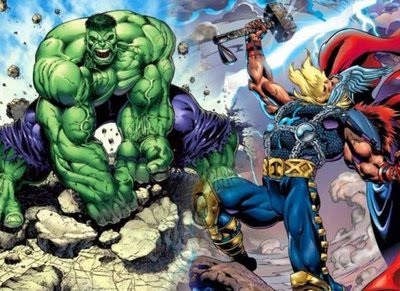
Hulk Vs. Thor Review


(I am not a comic otaku, I’m a manga otaku. But to appease the fans, I will try to reflect on the movie’s connection to the comic canon itself so as to demonstrate I do appreciate how it began. And there will be spoilers, since this is Direct to DVD anyway)

Hulk Vs. Thor is an interesting proposition in Marvel Comics, probably because it makes one think of parallels between this fight and the one in Marvel Vs. DC: Hulk vs. Superman, though that’s probably just me. In the comics, Hulk has been one of the few people to be able to fight evenly with Thor, one of Marvel Comic’s top three heroes, equivalent to Superman in DC. The premise of this film is a bit larger in scale, not to mention it involves a cast of characters on a different plane of existence, so we’ll see how it compares.

We begin with an explanation of the situation of things in Asgard, Odin going into hibernation and Thor and the other warriors fighting off the forces of Loki, Thor’s evil stepbrother, who tries to conquer Adgard every time Odin takes his week-long nap. We learn that there is one day left until Odin’s sleep is over and Loki with the help of his lover, Amora, has brought Bruce Banner from Midgard so he can utilize the power of the Hulk to defeat Thor. We shift to the Warriors Three speaking after the conclusion of the battle, while Thor complains to his lady Sif of the pointlessness of the cycle of battle they partake in. Sif comforts him by saying that at least it’s not Ragnarok, the end of all things. Meanwhile, Loki, with the help of Amora, the character also called the Enchantress, separates Bruce Banner from the Hulk and then enables Loki to control the Hulk. The Loki/Hulk hybrid beats the hell out of the Warriors Three along with everyone else around it. Amora notes that the spell is only so strong, since Hulk’s rage is fighting against the spell, indicating it may eventually be broken with sufficient power. Hulk/Loki has sufficiently pummeled Balder and he summons Thor, who tries to reason with the Hulk, thinking he is still Dr. Banner. The fight continues, with Loki revealing he is in control of the beast. After a while, Loki/Hulk manages to overwhelm Thor, but is unable to pick up Mjolnir After Thor retrieves it, the lightning he hits Loki/Hulk with breaks Amora’s spell linking Loki to Hulk, reducing Hulk to pure unbridled rage, making him what they term “a new Ragnarok on Asgard”. The Rage Hulk then proceeds to almost completely hand Thor his ass. Elsewhere, Loki now concludes Bruce Banner is useless and summarily kills him. Rage Hulk continues to beat Thor senseless and brings him to the edge of death, turning to go towards the light of Odin’s place of rest. Amora, in a very apologetic mood, heals Thor and brings him to Loki. Hulk continues to rage through Asgard, while the main plot continues at Loki’s hideout. Amora realizes Loki has killed Bruce Banner and thanks to rules in Asgard, Hela, the closest to Hades you can find in Norse mythology, has claimed Banner’s soul, and without his soul, Amora cannot send him back to Midgard. Thor sends her to defend the sleeping Odin along with Sif, who was left to defend Odin by Thor when he was summoned by Balder. Meanwhile, Loki is commanded by Thor to send his remaining forces to stop the Hulk while they go to Hel and try to negotiate with Hela about getting Banner’s soul back. While Hulk continues to fight against everyone stopping him from getting to Odin, we see Bruce Banner in an idyllic existence with Betty Ross and a child and everything is very pleasant. Little does he know he will be drawn out of the illusion and back into Hel; he is anguished as expected. Hulk continues to fight Sif and Amora, while Thor begs Bruce Banner to take on the responsibility to become the Hulk and stop his alter ego’s rampage in Asgard. Hela magically teleports Hulk to Hel and he fights Loki and Thor, subdued for a moment before he breaks free again. Bruce then confronts the Hulk, merging back with him and falling asleep after the raging his unbridled form had been doing. Hela sends Bruce back to Midgard, since he’s too dangerous to keep and also too precious to lose. After negotiating with Thor and Loki, she takes Loki’s soul temporarily to make amends for relinquishing the soul of Bruce Banner/Hulk. Afterwards, Odin gives a great honor to Bruce Banner for saving Asgard, praising the heroism of the mortal Bruce Banner, while we shift to said mortal walking down the highway, reminiscent of the finale to the 70s TV series.

The characterizations are very good, emphasizing the dynamics between the many characters of Asgard. Thor and Sif’s romantic coupling, as well as the potential romance one could see between Thor and Amora are depicted well for the awkward team of Amora and Sif against the Rage Hulk. Amora’s relationship with Loki is questionable, if only because she misunderstood what his intention was in controlling the Hulk, which only further emphasizes her feelings for Thor and her jealousy of Sif. The Warriors Three are comic relief at best in the film, but they do show the viewer that this is not based on real Norse mythology, but Marvel’s adaptation of it. Hela, based obviously on the goddess sharing the name with the Norse underworld, Hel, towers over Thor and Loki in size, not to mention in personality, her threats of taking their souls and maintaining her grip on the soul of Bruce Banner getting the message across that she is supreme in her realm, though she obviously has some authority she submits to Odin in granting souls passage to Valhalla. The rivalry between Thor and Loki is depicted quite well also, one brother cunning and devious and the other assertive and respected in Asgard. The desire for Mjolnir by Loki only further emphasizes the issues he has with the power Thor possesses. Bruce Banner’s mild mannered and otherwise wimpy mannerisms come out here as well as they did in Hulk Vs. Wolverine, begging people to listen to him as he knows best what dangers the Hulk poses to any world that challenges him. And the relationship implied by Thor with Bruce Banner is remarkable, a god showing such respect and consideration for a mere human. However powerful and nigh uncontrollable he may be as the Hulk, Thor recognizes the virtue in Bruce Banner as a person as well, which is the only theme that exists in the film that isn’t explained by the character relationships themselves.

My rating for this film is difficult to determine, since on the one hand, the plot is short and condensed, the film being under an hour in length. But on the other hand, it does leave one with a sense of completion, unlike Hulk Vs. Wolverine. However, there are discrepancies: Hulk only fights Thor while under the control of Loki or while raging uncontrollably as anger and fury incarnate, which makes one reflect that Hulk Vs. Wolverine was at least consistent with having the normal Hulk fight his opponent, whereas the main antagonists here are Loki and Hela. But all these things aside, it is still a film I’d highly recommend, a solid 5 with 70% recommendation. Until next time, Namaste and Aloha.

Saturday, March 27, 2010

Hulk Vs. Wolverine Review


(I am not a comic otaku, I’m a manga otaku. But to appease the fans, I will try to reflect on the movie’s connection to the comic canon itself so as to demonstrate I do appreciate how it began. And there will be spoilers, since this is Direct to DVD anyway)

I know I implied I’d never review another Hulk film, but in this case, I’ll make an exception because it’s two short films more than a single feature length film. Not to mention it’s two of the most intriguing conflicts in Marvel Comics that many fans have imagined, not to mention they’ve technically happened, though not necessarily as these films depict. In any case, Hulk Vs. Wolverine is what we start with, since it’s both shorter and first in the sequence of short films included in Hulk VS.

It starts with a scene that we actually don’t get to until later, where Wolverine regains consciousness and relocates his shoulder, trying to figure out what happened when the Hulk jumps in and resumes the fight already in progress. We flashback to Wolverine getting an assignment (when he was still under government authority I suppose) to seek out the Hulk and either detain or kill him. He’s dropped off in a large forest/mountain area and eventually finds Bruce Banner. After interrogating him a bit, he transforms back into the Hulk and the fight progresses to where it left off. They fight underwater and then Wolverine starts using the claws, but Hulk eventually overwhelms him and pummels his lights out. But as we know, Wolverine is not only nearly physically unbreakable with his adamantium skeleton, but his healing factor overrides a lot of what Hulk can dish out to him. He gets back up, much to the Hulk’s surprise and they duke it out some more before they’re both tranquilized by some old friends from Weapon X: Deadpool, Omega Red, Sabretooth and Lady Deathstrike (all whom don’t like Wolverine at all). We’re then treated to the usual flashback of how Wolverine got the adamantium and eventually escaped, though he was tested on and cloned in the process, giving us a subtle hint to the existence of X-23 in the process. We then return to the present and learn that Weapon X has resurfaced and intends to manipulate the Hulk to use it as a weapon just as they did with Logan, which indirectly created Deadpool. There’s a general atmosphere of everyone in the facility besides the Doctor wanting to kill Wolverine, but that’s to be expected with three of his primary rivals involved with Weapon X. Lady Deathstrike is particularly insistent with her bloodlust. Overall, the group had apparently planned to betray the Doctor anyway, killing him and then trying to kill Wolverine. But it doesn’t work out too well. Wolverine escapes and goes to save the Hulk. They’re ambushed, but Bruce Banner can’t Hulk out, since the emotional catalyst has been suppressed somehow, but Wolverine gives him some incentive by stabbing him with the claws to get the adrenaline going. Wolverine proceeds to fight Weapon X, doing pretty well until they get their act together and nearly kill him. But of course around that time, the Hulk arrives and starts beating the hell out of them, punching Sabretooth out of the facility, ripping Lady Deathstrike’s arms off and pretty much handing everyone their asses. Eventually, Hulk starts tearing down the place and whacks Wolverine out of it. And the film concludes with a black out conclusion with the victor left up in the air.

Wolverine’s character is spot on, there is little to complain about. We get the Weapon X flashbacks and the present Wolverine’s experiences presented quite well for a film barely over 30 minutes. Hulk talks a surprising amount in comparison to the live action depictions and has funny nicknames for almost everyone in the film, including “little man”, “claw people”, “talking man” and “ugly girl” (You can imagine which person he’s referring to in each case). Bruce Banner is depicted little and he is less than mild mannered, one might say, being submissive, weepy and otherwise emasculated as a character, though one can hardly blame him for such behavior in his situation. And the Weapon X characters are depicted very well also, each distinguished as a person, especially Lady Deathstrike and Deadpool, with Sabretooth and Omega Red somewhat similar, the only difference being backstory that wasn’t explained with them. Lady Deathstrike has a distinct orgasm face when she’s jamming her claws into Wolverine at one point, and Deadpool is the king of bad one-liners, which is common of him even in his comic book counterpart. The idea that all four of them hate him is convincing though, even if there is the absence of complete justification from the perspective of a newcomer to the Marvel universe.
The only theme really indicated is the connection of Wolverine’s past, both to Weapon X and to the people associated, to the Hulk, though themes in such a case as this film are few and far between, since one could concoct a number of plotlines to put the Hulk and Wolverine in the same area so they could fight each other. Wolverine’s relationships with others are thematic enough in investigating this film, what with calling Bruce Banner a crybaby and treating any person, male or female, equally when they fight him, slicing off arms or otherwise.

Overall, the film is good, but I’d only give it a 4 and maybe 80% recommendation, not only for the disappointing ending with no real victor noted (even though in all fairness there probably wouldn’t be a winner in the case of these two characters both indestructible for all intents and purposes). But if you want to see a brutal fight between X-Men characters, this is a good film for that, maybe even moreso than Hulk Vs. Thor, but we’ll see about that later. Until next time, Namaste and Aloha.

Friday, March 26, 2010

Doctor Strange Sorcerer Supreme Review


(I am not a comic otaku, I’m a manga otaku. But to appease the fans, I will try to reflect on the movie’s connection to the comic canon itself so as to demonstrate I do appreciate how it began. And there will be spoilers, since this is Direct to DVD anyway)

Doctor Strange is not a Marvel character I knew much about before I watched this film, and for good reason, since he’s very secretive and mysterious in the Marvel universe itself, only really being important with the Illuminati organization and the Defenders group, which ironically includes one of my other Marvel interests, the Hulk. This film is a good introduction to the character, even with deviations and additions to the original story that one can find. Not to mention at least one theme I will get into later that makes the film function on a deeper level than other films I’ve reviewed so far, since they haven’t confronted the issue as explicitly as this one.

The plot begins with a group of spiritual exterminators (if you will) that are chasing down a big ugly lizard. They succeed in taking it down, and in all the chaos, a man driving an expensive car almost crashes and manages to see the hunters even as they are supposed to be cloaked from the eyes of normal people. Later, the same man, Doctor Steven Strange, comes to the hospital and after prodding from the hospital administrator confronts a series of coma cases. After experiencing a strange vision after touching the forehead of the first patient, he leaves and has one of a few flashbacks about his sister who suffered from terrible migraines, no doubt a motivation for him to become a neurosurgeon. After leaving the hospital, Steven has a number of odd visions as he’s driving and spins out of control, crashing down a hill. After recovering, he is told that his hands are irreparably damaged from the crash and that he will never be a surgeon again. He desperately tries many treatments, bankrupting himself in the process. And after an attempt to kill himself, he is directed to Tibet by one of the mysterious “ghost hunters” from the beginning of the film. He gets there, nearly dying a few times and finally meets the Ancient One, who tells him he must look within himself for the cure, whatever it may be. He is given a modest room (just a bed of straw mostly) and is left to himself as the others take on “shadow hounds” in another “monster of the week” kind of mission where a few people die. Dr. Strange starts his training in earnest. The Chinese guide, Wong, inquires about the evil one Dormammu and how he is getting past his seal, but the issue is dodged from the moment. Strange continues the training, his quarters improving slightly as he smashes down a wall with a hammer, taking away the stones elsewhere and eventually having to start all over again because the wall is rebuilt. He eventually leaves in frustration, but after a final vision involving his failure to save his sister in surgery, he is confronted by the Ancient One in a vision and is motivated to continue, his room improving a bit again with a hot bath. The Ancient One sees another vision of Dormammu’s creatures and his guardian Mordo is sent to confront them, with orders to focus on one and then the next which Mordo is likely to disobey. Steven is confronted by the Ancient One again during his wall training and with a series of examples and progressively more spiritual feats, Dr. Strange progresses to the next level by beginning to “accept the unacceptable,” The two big ugly lizards with 8 eyes seen before are killed, but at the expense of 4 more students. Mordo is told he will not be the fabled Sorcerer Supreme’s successor because of his continued defiance. Instead he will train Steven for a time. He does this, but becomes frustrated as usual and Wong takes over, noting that Steven has a special power to absorb and redirect magic. Steven’s training progresses and he is able to do many things he was not before (like finally being able to shave, which was impossible before). His new appearance complete, he follows the group with the Ancient One to the Nexus of all dimensions, the Sanctum Sanctorum. We learn more about Dormammu and finds out that all the people in comas are being dominated and controlled by him, which Steven discovers through his heightened senses and the memory of the vision from before. He and Mordo are sent to recover the coma patients from the Dark Realm and after a while, it begins to work very well. But Mordo makes a deal with Dormammu and the Wing Mawg (or however it’s spelled) begins to attack the city. Many of the remaining students are killed and only the Ancient One survives the onslaught, before being slain by the new Mordo. Steven Strange takes on the Eye of Agamotto and is given the title of Sorceror Supreme in his master’s place. Wong and Mordo fight as Steven tries to stop Dormammu from being summoned. Wong is wounded and Steven easily defeats Mordo, who is then eaten by Dormammu who takes the Eye away and reconstitutes himself, releasing other evil spirits. Dr. Strange and Dormammu fight, and with Wong’s advice (subtle as it is) Strange defeats Dormammu, though it is indicated all the evil Dormammu released will have to be sealed or defeated in a future series. Steven then lets his colleague know (through a dream vision) that he is willing to give back now and with Wong they go to meet Strange’s future apprentice, Clea, leaving the film open to the future series or other films that may come.

Doctor Strange’s characterization is spot on, progressing from his selfish and otherwise skeptical persona in the beginning to his increasing acceptance of the unacceptable as the new Sorcerer Supreme. The appearance changes as well, from his initial appearance with black hair, his hair graying and his appearance disheveled as he attempts to fix his hands and his final appearance with some locks turned white and his changed outfit reminiscent of a true Sorcerer. His colleague Dr. Gina Atwater is minor, but her influence is important in the eventual change of personality Steven manifests in the conclusion. Wong and Mordo are the two most important of the various sorcery students under the Ancient One, most of them barely getting a name drop and dying in the series of battles. Wong is a traditional Chinese man, unassuming and devoted to his master, and Mordo’s equal in many respects, training Strange and serving as a constant mentor throughout the film. Mordo is ambitious and brutal, serving in the comics as Strange’s rival, though it seems unlikely that he will persist as such unless things change. His battle-addicted attitude shows through every conflict he has with people or spirit monsters through the narrative and is a great foil to the other varied characters. The Ancient One, similar to Wong in personality, is also more experienced and powerful, though his age is catching up with him and his training comes in the form of aphorisms in the vein of Buddhist masters, particularly such as in Tibetan Buddhism. The training of Strange reminds me of the Sage Milarepa’s somewhat, in that he is told to build and destroy three towers to suffer immense anguish and torment for his crimes in order to achieve nirvana in one lifetime. And Dormammu, while a bit extravagant in appearance, does fit the bill of a large demonic entity bent on conquering the world and bending it to his will. Though again the film seems to suggest he is gone forever, which ruins the possible future appearances he might have had in a series or another film.
The primary theme emphasized is the change of Strange in exposure to the many inexplicable spiritual experiences with the world of magic and sorcery, starting with the visions of the supposedly cloaked monster hunters and visions of flaming skulls and progressing to using magic himself as he accepts that there are mysterious forces in the world and yet with the proper mindset and talent, one is able to channel them. This is supplanted by the subplot involving a sister Strange technically didn’t have in the comics and his failure to save her as a surgeon, which made him desire fame and money in his later years because of his newfound distrust of trying to save people he cares for. This becomes especially important for Strange’s later acceptance of the unacceptable through his conversation with the Ancient One on how perception and experience are integral in determining how the world behaves for each individual, especially for those with magical heritage and powers. Not to mention the obvious idea that comes about with Mordo that sacrificing others for power is not exactly good for you, since you’ll get eaten by a fiery demon like a snack.

Overall, this film has a good plot, balanced protagonist and antagonists and conveys a message that resonates well with my own background in religious studies. Although admittedly the involvement of Marvel mythology only complicates this, not to mention the wasted potential of all the students tossed away like Star Trek extras. But this definitely gets a solid 5 in my book, though recommendation is probably 80-90% because of the esoteric nature of this Marvel character in particular, not nearly as accessible as Spiderman or the Hulk to just any person looking for an animated film. Until next time, Namaste and Aloha.

Tuesday, February 16, 2010

Part 3, Dolph Lundgren Is...the Punisher!


After having watched both the 2004 and 2008 renditions of The Punisher in film by Marvel Studios and Marvel Knights respectively, I finally got a copy of the oldest version of The Punisher in cinema. This features Dolph Lundgren, known better as Ivan Drago in Rocky 4 and featured in many other movies alongside Sylvester Stallone and John Van Damme. Part of my perception of this last film, though first chronologically in the series, is no doubt derived from my previously watching two better films in terms of canon and general experience with the Punisher. There are lots of moments in this version that make me feel like I’m watching a 80s film. There are comedic moments (kids trying to pull a yakuza off a bus window with their little hands for instance) and then there are moments that make you realize this is also for adults (kids being held hostage by yakuza for child slavery). If anything, this version of the Punisher shows its age as a late 80s film in that it seems both corny and tries to portray a very dark story of the dark character from Marvel.

Dolph Lundgren is a good Frank Castle for all intents and purposes, especially considering he has the height and weight down. But the backstory is raped the most in this version. Not only is Frank Castle a former cop in this version, but he has two daughters. I don’t know where they got this idea. At least their death is somewhat relevant with a car bomb meant for Frank from the mafia. If anything, it’s better than the backstory for Thomas Jane’s Frank Castle with a single son and a massacre at a family reunion. But the Punisher’s previous career seems implausible in comparison to the other Punishers, since I inquire where a police officer would learn how to operate heavy arms and explosives of the caliber the Punisher works with. Not to mention the hand to hand combat that involves Solid Snake-esque moves. The appearance of the Punisher’s classic death’s head symbol is lacking on the Punisher’s outfit, the only appearance of a skull coming in the form of a dagger that Dolph uses on the baddies as a calling card. It works as an attempt to spice up the use of the skull imagery, but it makes the Punisher out to be some villain, when he’s supposed to be an anti hero by any standard.

The setting would appear to be New York, though it’s debatable on that point. If anything, this film doesn’t suffer from what many would call a comic book movie killer, warped backstory narrative, which Jane’s Punisher suffered from in some regards. This film is told 5 years after Frank Castle’s tragic loss of his family, so there’s no need for any development of Frank as a character, which had to be done with Thomas Jane’s portrayal. This gives the film some similarity with Punisher Warzone in that they both take place after the fact and emphasize the Punisher’s present conflicts with others and how his past connects indirectly. The Punisher also seems too reckless as a character in this version, not taking the body armor offered to him, though any other portrayal has the Punisher recognizing his limits and not being a complete maniac. The only involvement with the Punisher’s divided religious background in seminary is in the last seconds of the film where he says he sometimes still asks God if what he does is right or wrong. He notes that he’s still waiting and until he gets an answer he will continue to fight crime as the Punisher. Even the 2004 version emphasizes Castle’s religiosity a bit more in some manners, while Warzone puts the character in a church at one point.

There is another large issue I find with this film and that is the involvement of a character known as “Shake”. He’s what I would call a washed up Shakespearean actor turned alcoholic drifter, but even that wouldn’t justify the amount of suck this guy manifests on screen. His first appearance involves him begging a guy for money in a bar and confusing him by using the word thespian, making an obvious gay joke which barely got a chuckle from me. Not to mention the guy is an informant for the Punisher as he seems to have connections to the mafia and such. Later, he attempts to convince Frank that he should save the children held hostage, and for all we know, he didn’t affect Frank’s decision to save them at all. He serves a similar purpose to Mickey Duka in Thomas Jane’s version of the Punisher. He’s a goofy comic relief character that has connections to the antagonists. These two are no Microchip, but heck, even Microchip’s appearance in Warzone makes me suspect that the directors didn’t want to end with any ideas of the Punisher having a sidekick, since they are either written off or in Warzone, killed off as a sacrifice to save other lives.

There’s also the involvement of Frank’s past partner, which I think might be an indirect reference to Jimmy Weeks, if he’s canon at all, in that we have someone connected to Frank’s past. In this version, there is a definite conflict, since Lou Gosset Jr.’s character thinks that his partner is identical with the Punisher figure who he has tracked for the last 5 years since the incident that he thought killed his partner. But when he finds him alive, Frank brushes him off, stating that “I don’t need your help. You don’t understand,” “I’m better off on my own,” “I don’t need a partner,” and of course, “Frank Castle is dead,” which was the one line that made me think that I was actually watching a Punisher movie instead of a cheap attempt to pass off the name into what was a film based on the popular Rambo series in some form or fashion. Overall, the importance of the character is only clear at the end when the fate of Frank Castle is unknown, though apparently he survives. But the angle and the scene with the detective on top of the roof screaming “Frank!” made me think that this movie had suggested Frank committed suicide, though his line before to the son of the mafia boss would imply he was going to continue his one man war on crime, so the odd shot with the partner screaming Frank’s name like he was gone confused me.

The villains in this film are good Punisher fodder. Many times his villains are one-shots and in this case, the primary villain is a female, which makes me think of Ma Gnucci from Welcome Back Frank. Lady Tanaka, who made me remember ironically that the name of the Yakuza leader in the Punisher game was also Tanaka, is a brutal and malicious character. The oddity in this gang is not her as the leader of the yakuza, but her daughter, who is both American and mute, adopted at some unknown age and for some unknown purpose; probably to train an heir that couldn’t speak against her and couldn’t be traced to her family. She uses all manner of hidden weapons, including her earrings, but is killed with some difficulty as she is too weak to fight against the Punisher. The backstory told by the other antagonist indicates Tanaka takes the yakuza code of loyalty seriously, to the point of killing her twin brother after serving him a nice meal at home. Her two main henchmen near the end of the film die amusingly. One gets impaled against a wall with a spear and the other falls over after a kick from Frank onto a spiky helmet (accident?) But the other antagonist, introduced roughly 20 or so minutes into the film, is also interesting, considering he’s the second to die, not the first. Gianni Franco’s involvement is that he is attempting to pull all the struggling mafia families together under one banner, his own. They attempt to do a protection mission with lots of marijuana or something and then Lady Tanaka’s scuba ninjas (with spiky ball shurikens) come in and kill the guys controlling the boat and most of the mafia families’ henchmen as well. Franco, along with four other mafia heads, is offered an alliance with the yakuza in exchange for money, but Franco doesn’t take it. He is lucky, as those four guys are later killed by Lady Tanaka with poisoned wine glasses (no joke). But the yakuza have taken the children of the mafia heads hostage to make them give the money that Tanaka uses for renovations or something, I guess. Onto deaths of the villains; Lady Tanaka takes a shard of glass to the forehead and falls over dead, almost having forced Franco to commit suicide to save his son. Gianni Franco takes Tommy from her and as they’re leaving, Frank sits up attempting to kill the last member of the mafia in the city. After an extended struggle, Frank manages to shoot Gianni at close range through his bulletproof vest and kill him. His son vows revenge, but after a tragic moment involving Frank pressuring the kid to kill him, little Tommy cannot bring himself to pull the trigger. And then Frank leaves to pray to God naked in a little shrine that he made in the sewers (I’m not kidding, you see it twice).

I’m not saying the movie sucks. Many people may actually find it likeable, even apart from all the complaints I’ve voiced. But the issue is how it lines up with one’s experience with the Punisher as a comic series and also whether it gives you the feel that the other two films gave you. So in all fairness, this is a comparison that might have gone better if I had watched the films in order, but I probably still would’ve found the later era films superior to this rip off of Stallone era films. Overall, the film makes me feel too young to have appreciated it as a teenager, but even so there’s the feeling that this isn’t the Punisher I experienced when I played the video game from 2005 which was my first real exposure to authentic Punisher lore and canon. I feel like I watched a movie based on the trope of a bad cop who doesn’t play by the rules. And they put the Punisher trademark in because Marvel needed more money. Avi Arad didn’t seem to be involved with this one, only Stan Lee serving as a creative consultant. The best I can say is that the movie makes a good attempt to keep the theme and general emotional response one wants from watching a film about Marvel’s most famous non-superpowered anti-hero. And if it succeeds at that, then I can only say that this is at the bottom of my list of Punisher films in terms of experience, but it didn’t kill the franchise as many claim. I may very well find that with my Hulk reviews in the future. We’ll see. Until next time, Namaste and aloha.

Monday, February 15, 2010

Part 2, Ray Stevenson is the Punisher!


Punisher Warzone is deemed by most Punisher fans to be the best in the series of three, and I agree (in part). The backstory is the most consistent after two mishaps. Frank Castle now has a son and daughter with his wife. And a larger point of contention for many fans is fixed as well. Instead of the family massacre that happened in the 2004 version or the car bomb that occurs in the 1989 version, Castle’s family stumbled upon a mafia hanging of an informant and to keep them quiet, the family was murdered in the park during what was supposed to be a happy picnic. The location is also canonically in New York, contrasting with the 2004 locale of Tampa, Florida, though this by no means makes the film more or less enjoyable, since location is only part of how one appreciates and is absorbed into the film’s narrative. Ray Stevenson’s portrayal is spot on to the Punisher’s divided psyche, desiring retribution for his family’s murders and yet also showing a human side that isn’t manifest as much with Dolph Lundgren’s Punisher. And it is only so much with Thomas Jane’s Punisher described as a work on progress in the 2004 film. That Frank Castle is not the complex figure having already suffered the tragedy and worked through it in some way that the other two films present. The best part of Warzone, many would say, is the brutality and violence that appears throughout the film. Frank Castle cuts off an old geriatric’s head, breaks his wife’s neck, headbutts a guy once, apparently incapacitating him and kicks a chair attempted to be used to strike him into the assailant’s face, lodging it in his eye. There are many other points that I could elaborate on, but suffice it to say, this film is not for the squeamish. Even I (who am not weak of constitution or squeamish by nature) grimaced at the targets of the Punisher’s more physical attacks, including a guy getting his face literally punched in. I’m guessing all the gun violence has been desensitized out of me.

In terms of supporting characters to the Punisher, Microchip, portrayed by Wayne Knight, best known in Jurassic Park as the hacker Dennis Nedry, is probably the best, seconded by Martin Soap, another comic book canon figure. Microchip’s identity is consistently portrayed as someone sympathetic to the Punisher’s cause, but also in disagreement with some choices he makes. In this version, Microchip is the one that is persevering with Frank to continue his quest for justice after having already avenged his family and feeling content. But in the comic, as I recall, he eventually started to question the Punisher’s methods as too extreme and was killed off in a confrontation. But Microchip’s fate in the film is not much better. First, his invalid mother, who serves as a point to capturing Microchip for the villains, gets her head blown off and then Microchip accepts his fate to be shot and taking the bullet as Frank takes out the other captor. Soap’s involvement is similar to his role in the comic as a police informant for Frank, also manifesting his support in the film by letting Frank out of his handcuffs and out of the squad car after his capture by what appears to be Lawrence Fishburne (but he’s not). He serves a similar role that Lou Gossett Jr. does in the 1989 film as one who pursues the Punisher as a reality, though most view him as a myth. His devotion to seeking out the Punisher is only seen more clearly in his supporting Frank however he can. Though it is debatable if he agrees because he sees it as the right way or if he himself admits he is too cowardly to take the Punisher’s ways on himself. Whereas the Punisher, who lives in what appears to be somewhere near the subway, contrasting with the sewer hideout in Dolph Lundgren’s portrayal and with the crumbling apartment complex in the 2004 film, connects with few people except Microchip and Soap.

This notion of the Punisher’s detached character is tested by the involvement of a subplot where Frank accidentally kills an undercover FBI agent, widowing his wife and daughter. He later comes to make amends and befriends the little girl, while her mother is less than enthusiastic to see him. After a confrontation where Frank reflects that she is much like his late wife, knowing how to use a gun, however much she didn’t want to confront the danger of being the wife of an FBI agent, he leaves. The two are taken to Frank’s hideout and then are kidnapped after Frank seeks out his enemies. They are then used as part of a dichotomy between Frank’s desire to protect the innocent and his loyalty to his friends, Microchip in particular. Soap would’ve been an interesting replacement, but Microchip is more invested in Punisher’s cause than Soap, so his eventual death is not as much of a blow as it would be for Soap. This is because we’ve established that Microchip only had his mother left, so with her death by Jigsaw, all ties have been severed. This seems to contrast strongly with Dolph Lundgren’s willingness to partner up with Franco after Budiansky was held ransom, though there was no dilemma of choosing between two victims, so the choice was more forced and quick than in the conclusion of Warzone.

The villains in Warzone are also interesting, though it’s a balance between the added in characters and the one canon villain, Punisher’s nemesis, Jigsaw. First, consider the added in characters. Jigsaw’s brother, not canon from what I can tell, is still an interesting addition. He seems to be completely insane, being restrained in the asylum and fed by orderlies, since he is catatonic as well. But when his shackles are removed, he speaks in an oddly childish manner. He then proceeds to attack the orderly, ripping out his organs to get his applesauce back (I’m not kidding). The involvement of the character is more important later as he kidnaps the widowed FBI agent and daughter, “axing” their guardian, a reformed Mexican gangbanger who is a friend of Microchip (yes, that’s his backstory) to get through to them. And in the final confrontation, he fights Frank in the upper levels of Jigsaw’s hideout, using a very erratic and wall-jumping style to overwhelm the Punisher. But eventually he is beaten and bruised and like many Punisher villains, killed by snapping his neck in a headlock. If anything, he gave one of the better Punisher fights in the films, besides Kevin Nash as the Russian. He takes the Punisher’s beatings and keeps getting up, almost enjoying the pain as was demonstrated when he smashed the mirrors in the first floor of the building so that Jigsaw didn’t have to look at his mutilated face. The guy jumped headfirst into a mirror, so suffice it to say, he takes even Frank Castle’s beatings easily. There’s also a subgroup of villains that seem to stand out. There’s the Italian mafia, Japanese yakuza and…the African American gangs… Really? Just seems a bit beyond stereotypical to me. Even the Eastern Europeans we see are less racist a subtype of criminal.

Jigsaw’s backstory is both consistent and inconsistent, which can be bad if done wrong, though this is effective nonetheless. Jigsaw, unlike his equivalent in the Punisher video game, is Billy Russoti, and not John Saint, which lines up with the comics. His mannerisms and general behavior are near identical to Jigsaw in the comics, concerned with his looks and after the surgery, becoming a maniacal crime boss, killing his plastic surgeon after being revealed that he was pieced together, not unlike his namesake. The way he gets his face destroyed differs from the comics, where he was thrown face-first through a plate glass window, cutting up his face, but not destroying it. I will warn you, the movie portrayal is far more disturbing. He is thrown into a glass crusher that spins the glass around a center point and smashes it all up, and the ensuing activity of the machine tears virtually all his face off and supposedly even damages his facial muscles and bones to some extent. The resulting face reminds me to some extent of Mason Verger from Hannibal with his sewn together face, though at least Verger didn’t have to feel the pain as much as Jigsaw did. Jigsaw’s end in the film didn’t leave open the door for a return. This disappointed me in some respect, since Jigsaw is well known to be the Punisher’s greatest adversary and if anything, his supposed death could’ve been more ambivalent than getting impaled with a spear and burned to death. But it still ends on a nice note of Punisher violence, going beyond what is necessary and being almost torture to the villain. This is both a gain and a loss to me. A sequel to this film could’ve had Jigsaw come back, albeit not necessarily as the main villain. But who knows if the sequel with Ray Stevenson will come to be with Barracuda…

I like to say this movie is tied with Thomas Jane’s Punisher, since Thomas Jane to me is the best Punisher appearance, voice and behavior wise, though Ray Stevenson is a close tie since his brutality is very similar, even resetting his nose with a pencil near the beginning of the film after his headbutt in the opening, which made me squirm and watch it a second time. The film is the most consistent with canon as well and even portrays Castle’s backstory a bit with relation to his previous priest training, speaking to a priest in the sanctuary as if they were old friends. Microchip, Soap and Jigsaw’s appearances all make this the favorite by die hard comic fans and I would agree in that regard. But I feel Thomas Jane’s version even with the retconned backstory and other changes, still keeps the same dark atmosphere that this version gives you in spades. So until next time, Namaste and aloha.

Sunday, February 14, 2010

Part 1, Thomas Jane is the Punisher!


Thomas Jane Is The Punisher (The Punisher 2004)


This was my most eagerly awaited project and the second comic book film I watched with a serious eye. The first was Daredevil, which gives you some idea of my next comic book film review, though I would need to watch it again to get reacquainted with it and the sequel Elektra. Thomas Jane’s version of the Punisher was one I looked forward to primarily because I was exposed to his voice initially in my first real exposure to the Punisher as a fleshed out character. I had read a single comic of the Punisher that I think had Warzone in the title, but I only remember that he stopped a terrorist with a fiberglass gun or something. The point is, Thomas Jane’s voice talent influenced me and probably still influences me in my enjoyment of this film, though it is still tied with Punisher Warzone in terms of overall enjoyment. Even Avi Arad and Stan Lee state in the documentary included in both versions of the DVD (theatrical and extended cut) that Thomas Jane was the only actor they had in mind when they were planning a Punisher film. Why they ignored their own judgment and hired Dolph Lundgren for the first Punisher film is beyond me, but it wasn’t Marvel Studios, so we have that much to be thankful for, I suppose.

Moving away from my apparent man crush on Thomas Jane (this is the only film I’ve seen him in btw) the backstory for the Punisher is flawed in some manner. First off, Frank Castle only has a son this time around, and the name isn’t even Frank Jr., it’s Will (though he calls him Buck for a nickname, which still confuses me). He is a Navy SEAL turned undercover agent and this background is somewhat consistent with his original backstory. And the massacre of his family is now literally all his immediate relatives and not simply his wife and kid(s). Parents, wife, son, cousins, aunts/uncles, they are all at a family reunion in Puerto Rico of all places. And due to a confusing initial plot where Frank Castle (undercover as a German arms dealer) caused the death of one of Howard Saint’s twin sons, the wife of the mafia lord wants his entire family dead. This lady is a temperamental bitch, considering all he did was kill one of her sons. I guess she doesn’t like the idea of her twins being separated, literally. The setting of the movie is also odd, as it’s explicitly said to be Tampa, Florida, completely on the south end of the eastern side of the U.S., whereas the canon comic is in New York. I won’t complain, since if anything, it makes the movie more interesting to have a new setting, but I imagine many would find this a comic book movie killer. That death being the blatant retconning of many aspects of the canon backstory of the main character. At least the death’s head is kept in this version, along with Warzone.

A subplot cut out of the theatrical cut involves Jimmy Weeks, a friend of Frank’s from the FBI, who also features in a pseudo-animated intro that involves Frank and Jimmy in Kuwait where his commanding officer is killed after not executing the “terrorists” through Frank’s judgment that they should be considered as criminals in the court of law, which affects him in the future it would seem. The subplot only involves a few scenes, one where Weeks gives Castle a watch after a goodbye party of sorts, another where he is interrogated by Saints’ thugs to give up information on Castle in order to cover his extreme gambling debts and the last where he is interrogated by Castle and eventually pressured into shooting himself with his own gun, leaving a much darker imprint on the viewer. Not to mention the movie itself is the longest of the three at a little over two hours even in the theatrical cut, the extended cut adding twenty minutes of footage.

John Saint, the remaining son, is one of three other characters related to Howard Saint in one way or another. He is apparently the identity of Jigsaw in the Punisher video game, though I dunno how this works, since I think his arm was blown off in the end of the film and even assuming he survives, he’d be an amputee as Jigsaw, which seems inaccurate with the game’s presentation. But he’s an interesting character on his own, even though he and his brother are otherwise identical. John being clean shaven and his brother having a thin mustache seems to indicate something about them. Bobby is apparently less loyal to his father and desires more independence, which causes his eventual death at the botched deal with his pot dealer (I’m serious). Although John Saint is also excessively independent from his father; apparently he attracts slutty bikini clad women, very much the playboy of the family. Quentin Glass is the right hand man of Howard Saint, though his main involvement in the story is to serve as a foil to Howard Saint for his affection for his wife. Quentin is revealed to be not only a sadist, but ironically enough, also homosexual, which only complicates his being accused by Howard Saint of sleeping with his wife due to a planted earring in his apartment. Livia is a pretty flat character all things considered, so I’ll just give you a rundown of her traits. She’s an attention whore who loves money like her husband and doesn’t appreciate anything given to her except by her husband and possibly her sons. Her death made me laugh so hard though, since even Howard apparently admits his paranoia of her sleeping with Quentin doesn’t make sense. He then proceeds to throw her off a bridge onto the train tracks where she is summarily killed. The last character to have any importance that isn’t explicitly an innocent person is Mickey Duka. He offers to help Bobby, who previously bought weed from him, with the deal to get illegal weapons in the beginning of the film. As a weasel-like character, he ducks for cover as everyone else is shot. And after being bailed out, he is nearly killed by Howard Saint, who decides that even though Mickey was the one who motivated Bobby to be drawn to his doom, his bodyguard, who wasn’t keeping an eye on him, deserved to die. Apparently he was also shot in the crotch, though that might just be me. Mickey is later kidnapped by Frank and tortured with a combination of a blowtorch, a popsicle and a slab of steak in that order (take from that what you will or watch the film). After giving up what information he has, Mickey serves as a figure similar to a Punisher sidekick in the Dolph Lundgren version called Shake, but I won’t get into details here. He aids Frank in understanding the patterns of behavior of the Saints and is the key to Frank eventually eliminating each of them in one way or another.

Howard Saint deserves his own paragraph, though I can only devote so much material to what is basically a stereotypical character. A suave, confident, and sociopathic crime boss who’s always wearing fancy suits and slicking back his hair, John Travolta does an excellent job in portraying a character that would otherwise have been a bit bland. He adds the spice necessary to make Howard Saint a compelling character who, while unsympathetic in one respect (dealing with Mexican/Cuban crimelords and killing off anyone who betrays him) he is also sympathetic in that he seems to genuinely love his children and wife, though his manifestation of this love can be quite macabre many times. Livia’s request to him after the funeral of Bobby, for example. Howard’s death is intriguing, getting shot just once, tied to his car by wires and then dragged through a lot where mines are planted under various cats, setting off a series of explosions that lights him on fire and then the car he is tied to explodes, cementing his death all the more with a pattern of exploded cars resembling the death’s head. Even if his death isn’t what Jigsaw’s is in Warzone, it still overrides even the deaths of the two antagonists in the 1989 version of the Punisher, much more toned down as you will see.

There are two other antagonists that have short lives but importance in the film as well. Harry Heck is the first, an odd caricature of Johnny Cash that carries not a weapon, but an actual guitar in the case he carries with him and is later killed by a ballistic knife launched from what appears to be a switchblade. Frank also steals his car, since Heck basically pushed him to drive the car off a rising bridge and then narrowly avoid hitting a girl, which then pushes it into a collision with another car. The Russian, a character canonized in the Punisher comics as one of his more deadly opponents, is portrayed by Kevin Nash, professional wrestler and all around big guy. The fight progresses through Castle’s apartment, smashing windows, the Russian using a pipe to bat back a grenade thrown by Castle (since apparently they play baseball in Russia) and Castle getting smashed by a toilet ripped out of the floor by the Russian as well. There’s not as much indication as in the game, but there is a Spiderman tattoo on the Russian’s right shoulder than you can see in one frame to suggest that the Russian is a fan of American comics, particularly Spiderman, which I believe is actually canon in the comics. His end is less excessive, as it takes a hint from the comics that he hates hot things, though in this context Frank was just desperate and threw a pot of boiling water that disfigures the behemoth’s face, after which the Punisher slams the Russian over the railing and down the stairs, where he breaks his neck. I almost would’ve wanted the fight to end how it did in the comic, which involved a hot pizza and the Punisher throwing his obese neighbor Bumpo’s fat ass on the Russian until he suffocated. But this is equally brutal. And that’s what counts to me for fights in the Punisher in general, if they keep that sense of tension and yet have a comicbook flair, such as one henchmen getting a paper cutter blade slammed into his forehead. Others come to mind from other films, but I’ll try to inject them in later.

The supporting characters of Joan, Spacker Dave and Bumpo deserve the second to final paragraph, since they are very much the heart of what remains of the Punisher’s humanity. Joan in particular, though altered from her shy mousy demeanor in the comics, is central, emphasizing to Frank that “good memories can save your life,” which later stops him from almost committing suicide through memories of his wife flooding back to him. She even tries to stop the odd habit Frank Castle has in this film of being an alcoholic after the death of his family. Although in this case it might be justified as opposed to if it was the death of one’s wife and children. He has literally no one to comfort him besides the drink before Joan and the others serve as a protective barrier to Frank going completely insane. Spacker Dave also serves a role of protector as he is interrogated by the sadist Quentin as to Frank’s whereabouts after getting hurt by the Russian and has each of his many piercings systematically pulled out. Bumpo’s role is less important, except as I mentioned with regards to the fight with the Russian, since he is the cook that boiled the water. Other than that, he only serves as the butt of many jokes to his fixation with cooking, threatening people with a rolling pin and at one point falling on Dave for an odd gay joke of sorts. While Frank is fixing a car in another scene, Bumpo also suggests that maybe Frank is an artist, I dunno where he got that idea (though I also can’t imagine where the Punisher found time to learn how to upgrade and fix a car in between learning Navy SEAL techs and martial arts/weaponry skills)

I’d like to clarify that I don’t imply that the other Punisher movies are below this. If anything, they have different charms to different people. If I was in an older generation, I might’ve actually enjoyed Dolph Lundgren as Frank Castle as much as I enjoyed Thomas Jane (since Dolph is the closest to the Punisher’s actual height and weight). But being as old as I am and having not been born at a point where I could’ve read the Punisher series when it started in the early 80s, I am forced to get a quicker exposure to the Punisher in the form of a video game that is consistent with a trade paperback titled Welcome Back Frank, including the Russian, Black Widow, Nick Fury, the Gnucci family and Jigsaw. While many comic book fans that are much older would say this ruins much of the Punisher’s backstory, even with Thomas Jane’s excellent performance, I see it as a retcon that keeps the Punisher relevant to today’s society. People can sympathize more with a man who lost his entire family and is driven to “pursue natural justice” than a man who merely lost his wife and kids and could be said to be behaving in a selfish manner. But regardless of how people react to my review, I just wanted to make it clear once again that these are merely my opinions and are not anything near fact, since in my whole life, I’ve read one Punisher comic, played the game twice and watched each of these movies once, including two cuts of Thomas Jane’s, which will definitely explain the length of this one. Until next time, Namaste and aloha.