Tuesday, March 30, 2010

Dragonball Evolution Review


(As a huge fan of this, I have potentially unreasonable expectations for this film. I feel it will be more important to focus on whether the film lines up with the spirit of the manga itself more than exact consistency with narrative and canon. There will be spoilers btw, since the manga spoilers are worth keeping secret)

I’ve been distracted from this project by the series of Marvel and DC animated films I’ve reviewed in the last week. But now I’ll try my hand at confronting something more in my area of knowledge, manga. I always wanted to do a review on Dragonball: Evolution. I had heard mostly bad reviews on this and the most positive review said that it was a good action film. This is a difficult task to undertake, since there is a risk that my standards for a film adapting such a great manga/anime could be too high. But I will attempt to take it as it is and note the discrepancies as I go without being overly critical of the film or accusing it to be completely without merit. So then, onto plot synopsis.

We begin with a backstory to what the rest of the film hinges on. Lord Piccolo and his disciple Oozaru waged a war against humanity to conquer the world. And they nearly succeeded, but for the use of the Mafuba that sealed Piccolo in the earth (even though he was originally sealed in a magical rice cooker. This time it’s underground in a metal teapot). And now 2000 years later, Goku, adopted son of Gohan, wise old master, trains with his elder. And afterwards he complains about how he’s picked on at school. His grandfather gives him sagely advice about fighting and a birthday present in the form of the Four Star Dragonball. With all 7, one can ask for one perfect wish; the usual McGuffin subplot. Goku then goes to school (by bike, no less) and is subsequently picked on after the bullies almost run him over and crush his bike. We finally see Piccolo, though a plot killer is that we never get an explanation of how he got out. He just broke the seal after 2000 years for some reason. He’s searching for the Dragonballs too. We shift back to the highschool where Goku is crushing on a girl named Chi Chi. He helps her with mechanical locker problems and is invited to a party. Upon entering the party that evening, the bullies shoo him away, but he decides to try to fight, in a way that ends up with the bullies hurting each other as he dodges every move they make. And their leader, in attempting to beat him with a lead pipe, smashes up his car. Back at the house, Gohan is attacked by Piccolo and the house is collapsed on top of him. Goku, sensing this, returns home and finds his dying grandfather, who tells him to seek out Master Roshi. Goku searches through the house, and runs into Bulma who sneaks in, trying to find her promethium orb, otherwise called a Dragonball. But she confuses the five star for the four star. The two decide to journey together and find Roshi, who gives them his Dragonball and agrees to go with them to find the rest while he trains Goku. They go to a sacred temple, but find it overrun by other fighters training, so they move on to find a Dragonball nearby. But they get trapped in a sinkhole made by Yamcha, the desert thief, who is eventually forced by Roshi to help them find a tunnel. Following it, they find the next Dragonball, but it’s up on a pillar surrounded by lava. Previously elsewhere, Piccolo gets his blood drawn and makes a bunch of ugly reptilian soldiers who intercept the group as they’re trying to get the ball. Goku makes a bridge of corpses across the lava, since they can’t regenerate in lava and gets the Dragonball, knocking away Piccolo’s assistant Mai as she tries to steal it. At Roshi’s suggestion they go to the city where the fighting tournament is to be held, where Roshi gets another Mafuba Jar made by his monk friends, while Goku, Bulma, and Yamcha mill around the town. Goku sees Chi Chi fight in the tournament and Bulma and Yamcha’s romantic moment is broken by a guy cutting a chicken’s head off (true boner killer material). Roshi later trains Goku in the Kame Hame Ha, the highest level of airbending (they use the term, so it’s not me plagiarizing Avatar: The Last Airbender). Goku eventually succeeds in mastering it with Chi Chi’s incentive to make out (yes, that’s the motivation. Teenagers…). Later that night, Mai, disguised as Chi Chi, steals the three Dragonballs and escapes after Goku, unable to tell the difference, hits the real Chi Chi fighting the disguised Mai. He has to be resuscitated by Roshi, since Mai shot him with a green bullet of some sort (Kryptonite? Nah). The group goes after Piccolo, Mafuba Jar in hand and the fight begins. Goku is told by Piccolo that he is Oozaru and as the complete solar eclipse (spoken of while Goku was fantasizing about Chi Chi in a field of flowers eating strawberries) begins, Goku transforms and starts raging out of control. Roshi attempts the Mafuba, but Piccolo interrupts the process and Roshi subsequently dies, though he does help Goku control himself and revert back to human form. Elsewhere, Yamcha helps Bulma as she sucks at her fight with Mai and almost gets her Dragonball (that she picked up during Piccolo’s ceremony) stolen. After Goku fights and defeats Piccolo (not impaling him with a huge Kamehameha powered punch, but handing him his ass anyway) they use the 7 Dragonballs to bring Roshi back to life and they begin their search all over again. Before this, Goku goes to make out with Chi Chi and then in a typical lover’s spat, they have a hand to hand martial arts duel to settle the argument (totally normal). And the film ends abruptly there, but we get an ending credits scene leaving the film open to a sequel.

Characterizations are pretty inconsistent in terms of the canon, but you get the general idea of the character, even if personality is altered in a few cases. Take Goku, who controversially enough, is portrayed by a white guy (which isn’t the real problem). His character reminds me of his future son, who has awkward moments in high school and girl troubles. His father’s toughness and attitude are there, but the fact that they tried to make the film more accessible to a modern audience means they pulled the plot of Dragonball and put it into the Dragonball Z universe where there’s more advanced technology. The original Goku, isolated and innocent, was not one to be concerned with popularity or sex, making many fans of the manga/anime predictably rip on the destruction of Goku’s character. While I agree, it’s probably better for Goku in this modern adaptation to be more accessible to teenage fans and behave like Gohan from Dragonball Z. Piccolo, our main antagonist, is portrayed well, though many fans of Dragonball Z might think he’s Piccolo Jr, who is actually the son of the character in this adaptation, Demon King Piccolo, a primary antagonist in Dragonball. The lust for power and his cold nature come out great. The film makes a reference to Piano, Drum and Tambourine; sons spit out by King Piccolo in the manga/anime and eventually killed. Though the reference is awkward, it helped retain my faith in the film. Grandpa Gohan (namesake of the Gohan referenced previously) is done well, though he reminds me too much of the grandfather from Three Ninjas. His role is minor and yet his influence on Goku is important for how the rest of the film plays out. As important as he was, they didn’t mess him up, which gets kudos from me. Bulma is hardly changed, though she didn’t really take a fighting role in the series. Her personality and balance of feminine charm and technical genius is presented well. Chi Chi, the other female lead, is good even if they rip her father out of the story. Her father in the anime/manga was Ox King, a fellow training partner of Gohan in the past under Master Roshi. She fights well and her relationship with Goku, though rushed, does keep with the canon. On a side note, Goku’s innocence and Chi Chi’s insistence as a 12 year old about getting married would’ve been a fun thing to try to portray if the film was more along the lines of the original manga/anime. Yamcha is a minor character, but not depicted as well as I would hope for all his unimportance to the plot. The original was a badass desert thief that used the Wolf Fang Fist and a sword. This version uses traps and has little to no fighting experience. His surfer accent is out of place as well, but at least they keep his relationship with Bulma so as not to destroy his reputation completely. His partner Puar, the floating cat that can transform, is missing, but I imagine the budget was directed elsewhere so he was cut out to begin with (along with Oolong, the transforming pig anthro). Master Roshi is done well, though my first reaction was “Why does he look like a derelict instead of a hermit?” He’s definitely a modernized version, but his perverted nature is still depicted well with the shirt he is first seen wearing, the bikini magazine in his house and his interactions with Bulma (sexual harassment and all). And his role in the series is the same, training Goku and sacrificing himself to try to defeat Piccolo. The idea of the 7 mystics that used the Mafuba in the past could’ve been avoided and replaced with another reference to the series. Master Roshi’s master, Mutaito, was the original one who sealed Piccolo, so why not inject him in as Roshi’s ancestor or something instead of making a painfully obvious parallel to the other set of 7? Mai’s involvement is important, though she never gets a name drop. Not to mention her depiction in the comics was not able to shapeshift and dodge bullets. And her partner (talking humanoid fox) and her original employer are both absent. Emperor Pilaf was a short little blue goblin like thing and just comic relief in the manga, never a real threat. There are other characters, but not that are in the series. Sifu Norris is odd, not to mention the black bully in Goku’s high school. But moving on.

The primary theme centers on Goku’s journey of self discovery. Progressively you get hints that Goku is connected to Oozaru and then the revelation that he is Oozaru doesn’t surprise you coming from Piccolo’s mouth. His grandpa also emphasizes Goku having faith in who he is; which is the crux of his eventual conclusion that he is both Oozaru and Goku and yet maintain the human form without losing control. There is an initial division between his perceived role as Piccolo’s servant and his familial love for his adoptive grandfather. But as he concludes that he is Goku primarily and that his duty to Piccolo will not rule him, it completes him as a character, however different he may be from Goku in the manga/anime, unaware of his past transformations and only realizing it in DBZ. Either way, the investigation of Goku’s internal conflict and resolution thereof is progressive but not too obvious.

Overall, the film would probably get a 3, my lowest rank so far of films overall. The action is subdued and the romance dominates male/female character interactions. And one of the most difficult to accept things is the unexplained resurrection of Piccolo. The concluding scene involves Piccolo as well, but sequel material is different. If you don’t give an explanation of how the bad guy gets free from his imprisonment, it kind of ruins the viewer’s mood of suspense at the antagonist’s arrival. The modernization of the film is probably what gets it a recommendation from me at all, but I’d have to be fair overall. The differences from the manga are there for expediency’s sake. If you tried to portray all of Dragonball even with cutting out minor scenes, you’d have a trilogy on your hands already. The real objection I have is the lack of resonance the film has with Dragonball as a series. Dragonball Z is the more popular series with many and this film takes advantage of that by making the feel more sci fi than fantasy, which was what Dragonball Z had to appeal. You felt like Dragonball was more like a fairy tale or fantasy quest. With this film, it seems like they tried to give the magical background of Dragonball its place with the concepts of Ki, Elements and of course the Dragonballs granting a wish. But there was a strong intent to root the world more in Dragonball Z, where technology was advanced and the rural areas grew smaller and smaller in importance. The title Dragonball Evolution works, though it does deceive fans who think it is trying to bring Dragonball’s story to the screen, when the reality is that it’s bringing more of a Dragonball Z atmosphere. I could rant forever on how this differs from both Dragonball and Dragonball Z, but my general verdict is that the film is a good mix of sci fi and fantasy action, though admittedly taking a bit too much creative license with the original material. So even if you’re new to Dragonball, you could watch this for the feel of a quest to save the world, not unlike Lord of the Rings for instance. Final rating is 3 out of 5 for disappointments and incredulity factor, but an 80-90% recommendation for enjoyment in general. Until next time, Namaste and Aloha.

Sunday, March 28, 2010

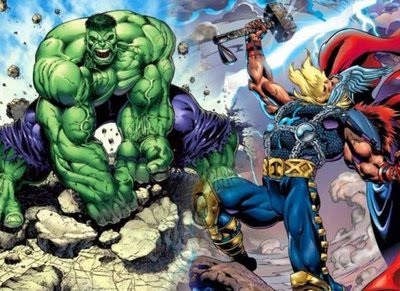
Hulk Vs. Thor Review


(I am not a comic otaku, I’m a manga otaku. But to appease the fans, I will try to reflect on the movie’s connection to the comic canon itself so as to demonstrate I do appreciate how it began. And there will be spoilers, since this is Direct to DVD anyway)

Hulk Vs. Thor is an interesting proposition in Marvel Comics, probably because it makes one think of parallels between this fight and the one in Marvel Vs. DC: Hulk vs. Superman, though that’s probably just me. In the comics, Hulk has been one of the few people to be able to fight evenly with Thor, one of Marvel Comic’s top three heroes, equivalent to Superman in DC. The premise of this film is a bit larger in scale, not to mention it involves a cast of characters on a different plane of existence, so we’ll see how it compares.

We begin with an explanation of the situation of things in Asgard, Odin going into hibernation and Thor and the other warriors fighting off the forces of Loki, Thor’s evil stepbrother, who tries to conquer Adgard every time Odin takes his week-long nap. We learn that there is one day left until Odin’s sleep is over and Loki with the help of his lover, Amora, has brought Bruce Banner from Midgard so he can utilize the power of the Hulk to defeat Thor. We shift to the Warriors Three speaking after the conclusion of the battle, while Thor complains to his lady Sif of the pointlessness of the cycle of battle they partake in. Sif comforts him by saying that at least it’s not Ragnarok, the end of all things. Meanwhile, Loki, with the help of Amora, the character also called the Enchantress, separates Bruce Banner from the Hulk and then enables Loki to control the Hulk. The Loki/Hulk hybrid beats the hell out of the Warriors Three along with everyone else around it. Amora notes that the spell is only so strong, since Hulk’s rage is fighting against the spell, indicating it may eventually be broken with sufficient power. Hulk/Loki has sufficiently pummeled Balder and he summons Thor, who tries to reason with the Hulk, thinking he is still Dr. Banner. The fight continues, with Loki revealing he is in control of the beast. After a while, Loki/Hulk manages to overwhelm Thor, but is unable to pick up Mjolnir After Thor retrieves it, the lightning he hits Loki/Hulk with breaks Amora’s spell linking Loki to Hulk, reducing Hulk to pure unbridled rage, making him what they term “a new Ragnarok on Asgard”. The Rage Hulk then proceeds to almost completely hand Thor his ass. Elsewhere, Loki now concludes Bruce Banner is useless and summarily kills him. Rage Hulk continues to beat Thor senseless and brings him to the edge of death, turning to go towards the light of Odin’s place of rest. Amora, in a very apologetic mood, heals Thor and brings him to Loki. Hulk continues to rage through Asgard, while the main plot continues at Loki’s hideout. Amora realizes Loki has killed Bruce Banner and thanks to rules in Asgard, Hela, the closest to Hades you can find in Norse mythology, has claimed Banner’s soul, and without his soul, Amora cannot send him back to Midgard. Thor sends her to defend the sleeping Odin along with Sif, who was left to defend Odin by Thor when he was summoned by Balder. Meanwhile, Loki is commanded by Thor to send his remaining forces to stop the Hulk while they go to Hel and try to negotiate with Hela about getting Banner’s soul back. While Hulk continues to fight against everyone stopping him from getting to Odin, we see Bruce Banner in an idyllic existence with Betty Ross and a child and everything is very pleasant. Little does he know he will be drawn out of the illusion and back into Hel; he is anguished as expected. Hulk continues to fight Sif and Amora, while Thor begs Bruce Banner to take on the responsibility to become the Hulk and stop his alter ego’s rampage in Asgard. Hela magically teleports Hulk to Hel and he fights Loki and Thor, subdued for a moment before he breaks free again. Bruce then confronts the Hulk, merging back with him and falling asleep after the raging his unbridled form had been doing. Hela sends Bruce back to Midgard, since he’s too dangerous to keep and also too precious to lose. After negotiating with Thor and Loki, she takes Loki’s soul temporarily to make amends for relinquishing the soul of Bruce Banner/Hulk. Afterwards, Odin gives a great honor to Bruce Banner for saving Asgard, praising the heroism of the mortal Bruce Banner, while we shift to said mortal walking down the highway, reminiscent of the finale to the 70s TV series.

The characterizations are very good, emphasizing the dynamics between the many characters of Asgard. Thor and Sif’s romantic coupling, as well as the potential romance one could see between Thor and Amora are depicted well for the awkward team of Amora and Sif against the Rage Hulk. Amora’s relationship with Loki is questionable, if only because she misunderstood what his intention was in controlling the Hulk, which only further emphasizes her feelings for Thor and her jealousy of Sif. The Warriors Three are comic relief at best in the film, but they do show the viewer that this is not based on real Norse mythology, but Marvel’s adaptation of it. Hela, based obviously on the goddess sharing the name with the Norse underworld, Hel, towers over Thor and Loki in size, not to mention in personality, her threats of taking their souls and maintaining her grip on the soul of Bruce Banner getting the message across that she is supreme in her realm, though she obviously has some authority she submits to Odin in granting souls passage to Valhalla. The rivalry between Thor and Loki is depicted quite well also, one brother cunning and devious and the other assertive and respected in Asgard. The desire for Mjolnir by Loki only further emphasizes the issues he has with the power Thor possesses. Bruce Banner’s mild mannered and otherwise wimpy mannerisms come out here as well as they did in Hulk Vs. Wolverine, begging people to listen to him as he knows best what dangers the Hulk poses to any world that challenges him. And the relationship implied by Thor with Bruce Banner is remarkable, a god showing such respect and consideration for a mere human. However powerful and nigh uncontrollable he may be as the Hulk, Thor recognizes the virtue in Bruce Banner as a person as well, which is the only theme that exists in the film that isn’t explained by the character relationships themselves.

My rating for this film is difficult to determine, since on the one hand, the plot is short and condensed, the film being under an hour in length. But on the other hand, it does leave one with a sense of completion, unlike Hulk Vs. Wolverine. However, there are discrepancies: Hulk only fights Thor while under the control of Loki or while raging uncontrollably as anger and fury incarnate, which makes one reflect that Hulk Vs. Wolverine was at least consistent with having the normal Hulk fight his opponent, whereas the main antagonists here are Loki and Hela. But all these things aside, it is still a film I’d highly recommend, a solid 5 with 70% recommendation. Until next time, Namaste and Aloha.

Saturday, March 27, 2010

Hulk Vs. Wolverine Review


(I am not a comic otaku, I’m a manga otaku. But to appease the fans, I will try to reflect on the movie’s connection to the comic canon itself so as to demonstrate I do appreciate how it began. And there will be spoilers, since this is Direct to DVD anyway)

I know I implied I’d never review another Hulk film, but in this case, I’ll make an exception because it’s two short films more than a single feature length film. Not to mention it’s two of the most intriguing conflicts in Marvel Comics that many fans have imagined, not to mention they’ve technically happened, though not necessarily as these films depict. In any case, Hulk Vs. Wolverine is what we start with, since it’s both shorter and first in the sequence of short films included in Hulk VS.

It starts with a scene that we actually don’t get to until later, where Wolverine regains consciousness and relocates his shoulder, trying to figure out what happened when the Hulk jumps in and resumes the fight already in progress. We flashback to Wolverine getting an assignment (when he was still under government authority I suppose) to seek out the Hulk and either detain or kill him. He’s dropped off in a large forest/mountain area and eventually finds Bruce Banner. After interrogating him a bit, he transforms back into the Hulk and the fight progresses to where it left off. They fight underwater and then Wolverine starts using the claws, but Hulk eventually overwhelms him and pummels his lights out. But as we know, Wolverine is not only nearly physically unbreakable with his adamantium skeleton, but his healing factor overrides a lot of what Hulk can dish out to him. He gets back up, much to the Hulk’s surprise and they duke it out some more before they’re both tranquilized by some old friends from Weapon X: Deadpool, Omega Red, Sabretooth and Lady Deathstrike (all whom don’t like Wolverine at all). We’re then treated to the usual flashback of how Wolverine got the adamantium and eventually escaped, though he was tested on and cloned in the process, giving us a subtle hint to the existence of X-23 in the process. We then return to the present and learn that Weapon X has resurfaced and intends to manipulate the Hulk to use it as a weapon just as they did with Logan, which indirectly created Deadpool. There’s a general atmosphere of everyone in the facility besides the Doctor wanting to kill Wolverine, but that’s to be expected with three of his primary rivals involved with Weapon X. Lady Deathstrike is particularly insistent with her bloodlust. Overall, the group had apparently planned to betray the Doctor anyway, killing him and then trying to kill Wolverine. But it doesn’t work out too well. Wolverine escapes and goes to save the Hulk. They’re ambushed, but Bruce Banner can’t Hulk out, since the emotional catalyst has been suppressed somehow, but Wolverine gives him some incentive by stabbing him with the claws to get the adrenaline going. Wolverine proceeds to fight Weapon X, doing pretty well until they get their act together and nearly kill him. But of course around that time, the Hulk arrives and starts beating the hell out of them, punching Sabretooth out of the facility, ripping Lady Deathstrike’s arms off and pretty much handing everyone their asses. Eventually, Hulk starts tearing down the place and whacks Wolverine out of it. And the film concludes with a black out conclusion with the victor left up in the air.

Wolverine’s character is spot on, there is little to complain about. We get the Weapon X flashbacks and the present Wolverine’s experiences presented quite well for a film barely over 30 minutes. Hulk talks a surprising amount in comparison to the live action depictions and has funny nicknames for almost everyone in the film, including “little man”, “claw people”, “talking man” and “ugly girl” (You can imagine which person he’s referring to in each case). Bruce Banner is depicted little and he is less than mild mannered, one might say, being submissive, weepy and otherwise emasculated as a character, though one can hardly blame him for such behavior in his situation. And the Weapon X characters are depicted very well also, each distinguished as a person, especially Lady Deathstrike and Deadpool, with Sabretooth and Omega Red somewhat similar, the only difference being backstory that wasn’t explained with them. Lady Deathstrike has a distinct orgasm face when she’s jamming her claws into Wolverine at one point, and Deadpool is the king of bad one-liners, which is common of him even in his comic book counterpart. The idea that all four of them hate him is convincing though, even if there is the absence of complete justification from the perspective of a newcomer to the Marvel universe.
The only theme really indicated is the connection of Wolverine’s past, both to Weapon X and to the people associated, to the Hulk, though themes in such a case as this film are few and far between, since one could concoct a number of plotlines to put the Hulk and Wolverine in the same area so they could fight each other. Wolverine’s relationships with others are thematic enough in investigating this film, what with calling Bruce Banner a crybaby and treating any person, male or female, equally when they fight him, slicing off arms or otherwise.

Overall, the film is good, but I’d only give it a 4 and maybe 80% recommendation, not only for the disappointing ending with no real victor noted (even though in all fairness there probably wouldn’t be a winner in the case of these two characters both indestructible for all intents and purposes). But if you want to see a brutal fight between X-Men characters, this is a good film for that, maybe even moreso than Hulk Vs. Thor, but we’ll see about that later. Until next time, Namaste and Aloha.

Friday, March 26, 2010

Hulk VS Dual Review Preview


I almost promised myself I'd never review another Hulk adaptation, but Hulk VS is too appealing not too. I have the rough drafts ready and I may start posting the first one tonight, but more than likely I'll put these off until next week to keep you interested (advertising tactics and all). Either way, here's a nice picture depicting the titles themselves

Doctor Strange Sorcerer Supreme Review


(I am not a comic otaku, I’m a manga otaku. But to appease the fans, I will try to reflect on the movie’s connection to the comic canon itself so as to demonstrate I do appreciate how it began. And there will be spoilers, since this is Direct to DVD anyway)

Doctor Strange is not a Marvel character I knew much about before I watched this film, and for good reason, since he’s very secretive and mysterious in the Marvel universe itself, only really being important with the Illuminati organization and the Defenders group, which ironically includes one of my other Marvel interests, the Hulk. This film is a good introduction to the character, even with deviations and additions to the original story that one can find. Not to mention at least one theme I will get into later that makes the film function on a deeper level than other films I’ve reviewed so far, since they haven’t confronted the issue as explicitly as this one.

The plot begins with a group of spiritual exterminators (if you will) that are chasing down a big ugly lizard. They succeed in taking it down, and in all the chaos, a man driving an expensive car almost crashes and manages to see the hunters even as they are supposed to be cloaked from the eyes of normal people. Later, the same man, Doctor Steven Strange, comes to the hospital and after prodding from the hospital administrator confronts a series of coma cases. After experiencing a strange vision after touching the forehead of the first patient, he leaves and has one of a few flashbacks about his sister who suffered from terrible migraines, no doubt a motivation for him to become a neurosurgeon. After leaving the hospital, Steven has a number of odd visions as he’s driving and spins out of control, crashing down a hill. After recovering, he is told that his hands are irreparably damaged from the crash and that he will never be a surgeon again. He desperately tries many treatments, bankrupting himself in the process. And after an attempt to kill himself, he is directed to Tibet by one of the mysterious “ghost hunters” from the beginning of the film. He gets there, nearly dying a few times and finally meets the Ancient One, who tells him he must look within himself for the cure, whatever it may be. He is given a modest room (just a bed of straw mostly) and is left to himself as the others take on “shadow hounds” in another “monster of the week” kind of mission where a few people die. Dr. Strange starts his training in earnest. The Chinese guide, Wong, inquires about the evil one Dormammu and how he is getting past his seal, but the issue is dodged from the moment. Strange continues the training, his quarters improving slightly as he smashes down a wall with a hammer, taking away the stones elsewhere and eventually having to start all over again because the wall is rebuilt. He eventually leaves in frustration, but after a final vision involving his failure to save his sister in surgery, he is confronted by the Ancient One in a vision and is motivated to continue, his room improving a bit again with a hot bath. The Ancient One sees another vision of Dormammu’s creatures and his guardian Mordo is sent to confront them, with orders to focus on one and then the next which Mordo is likely to disobey. Steven is confronted by the Ancient One again during his wall training and with a series of examples and progressively more spiritual feats, Dr. Strange progresses to the next level by beginning to “accept the unacceptable,” The two big ugly lizards with 8 eyes seen before are killed, but at the expense of 4 more students. Mordo is told he will not be the fabled Sorcerer Supreme’s successor because of his continued defiance. Instead he will train Steven for a time. He does this, but becomes frustrated as usual and Wong takes over, noting that Steven has a special power to absorb and redirect magic. Steven’s training progresses and he is able to do many things he was not before (like finally being able to shave, which was impossible before). His new appearance complete, he follows the group with the Ancient One to the Nexus of all dimensions, the Sanctum Sanctorum. We learn more about Dormammu and finds out that all the people in comas are being dominated and controlled by him, which Steven discovers through his heightened senses and the memory of the vision from before. He and Mordo are sent to recover the coma patients from the Dark Realm and after a while, it begins to work very well. But Mordo makes a deal with Dormammu and the Wing Mawg (or however it’s spelled) begins to attack the city. Many of the remaining students are killed and only the Ancient One survives the onslaught, before being slain by the new Mordo. Steven Strange takes on the Eye of Agamotto and is given the title of Sorceror Supreme in his master’s place. Wong and Mordo fight as Steven tries to stop Dormammu from being summoned. Wong is wounded and Steven easily defeats Mordo, who is then eaten by Dormammu who takes the Eye away and reconstitutes himself, releasing other evil spirits. Dr. Strange and Dormammu fight, and with Wong’s advice (subtle as it is) Strange defeats Dormammu, though it is indicated all the evil Dormammu released will have to be sealed or defeated in a future series. Steven then lets his colleague know (through a dream vision) that he is willing to give back now and with Wong they go to meet Strange’s future apprentice, Clea, leaving the film open to the future series or other films that may come.

Doctor Strange’s characterization is spot on, progressing from his selfish and otherwise skeptical persona in the beginning to his increasing acceptance of the unacceptable as the new Sorcerer Supreme. The appearance changes as well, from his initial appearance with black hair, his hair graying and his appearance disheveled as he attempts to fix his hands and his final appearance with some locks turned white and his changed outfit reminiscent of a true Sorcerer. His colleague Dr. Gina Atwater is minor, but her influence is important in the eventual change of personality Steven manifests in the conclusion. Wong and Mordo are the two most important of the various sorcery students under the Ancient One, most of them barely getting a name drop and dying in the series of battles. Wong is a traditional Chinese man, unassuming and devoted to his master, and Mordo’s equal in many respects, training Strange and serving as a constant mentor throughout the film. Mordo is ambitious and brutal, serving in the comics as Strange’s rival, though it seems unlikely that he will persist as such unless things change. His battle-addicted attitude shows through every conflict he has with people or spirit monsters through the narrative and is a great foil to the other varied characters. The Ancient One, similar to Wong in personality, is also more experienced and powerful, though his age is catching up with him and his training comes in the form of aphorisms in the vein of Buddhist masters, particularly such as in Tibetan Buddhism. The training of Strange reminds me of the Sage Milarepa’s somewhat, in that he is told to build and destroy three towers to suffer immense anguish and torment for his crimes in order to achieve nirvana in one lifetime. And Dormammu, while a bit extravagant in appearance, does fit the bill of a large demonic entity bent on conquering the world and bending it to his will. Though again the film seems to suggest he is gone forever, which ruins the possible future appearances he might have had in a series or another film.
The primary theme emphasized is the change of Strange in exposure to the many inexplicable spiritual experiences with the world of magic and sorcery, starting with the visions of the supposedly cloaked monster hunters and visions of flaming skulls and progressing to using magic himself as he accepts that there are mysterious forces in the world and yet with the proper mindset and talent, one is able to channel them. This is supplanted by the subplot involving a sister Strange technically didn’t have in the comics and his failure to save her as a surgeon, which made him desire fame and money in his later years because of his newfound distrust of trying to save people he cares for. This becomes especially important for Strange’s later acceptance of the unacceptable through his conversation with the Ancient One on how perception and experience are integral in determining how the world behaves for each individual, especially for those with magical heritage and powers. Not to mention the obvious idea that comes about with Mordo that sacrificing others for power is not exactly good for you, since you’ll get eaten by a fiery demon like a snack.

Overall, this film has a good plot, balanced protagonist and antagonists and conveys a message that resonates well with my own background in religious studies. Although admittedly the involvement of Marvel mythology only complicates this, not to mention the wasted potential of all the students tossed away like Star Trek extras. But this definitely gets a solid 5 in my book, though recommendation is probably 80-90% because of the esoteric nature of this Marvel character in particular, not nearly as accessible as Spiderman or the Hulk to just any person looking for an animated film. Until next time, Namaste and Aloha.

Thursday, March 25, 2010

Secondary Introduction

I had put this off for about a week or so when I considered that it'd probably be a good idea to make two proverbial spheres for my writing. On the one hand, I can express my thoughts and opinions on current events (that run the gammut from GLBT to abortion to religious issues that pigue my intrigue). And on this hand I can post reviews on various films I see. I've done a lot already and while I imagine I won't run out any time soon, at least until I run out of DC and Marvel films in particular, I can't promise I'll update this one as much as To Hold Nothing, since that's my primary interest, one might say. In any case, you'll notice I've uploaded over 10 reviews already, so that you can get an idea of what my general interests are. I will review other films that don't fit the usual standard, but my common interest will be comic book adaptations, live action or otherwise. So, until then, keep reading and keep watching.

Wonder Woman 2009 Review


(I am not a comic otaku, I’m a manga otaku. But to appease the fans, I will try to reflect on the movie’s connection to the comic canon itself so as to demonstrate I do appreciate how it began. And there will be spoilers, since this is Direct to DVD anyway)

The Wonder Woman franchise is not nearly as appreciated as it probably was back in the 40s and 60-70s period. Wonder Woman has aged awkwardly, even if she still is popular, evidenced by sales of her comics today. But I imagine there’s something of an opposition by some feminists today if only because of her clothing choice (scantily clad and all) and a general problem with her weakness being bondage by men (Curse of Aphrodite I believe). I’m not sure if the latter is actually emphasized as much, but I imagine she still needs a weakness: and what better weakness to use than a Greek mythology reference to when Aphrodite and Ares were caught by Hephaestus in the middle of sex?

The animated film is supposed to be a reference to the “Gods and Mortals” arc that was a reboot of Wonder Woman in the late 80s and it does follow the plot in the basic premises, though I’ll get to the discrepancies later. It begins with a flashback to a fight between the Amazons (who apparently lived with men at this point in time and only became ultra feminists afterwards) and the forces of Ares, the primary antagonist in the film. There is a particular clash between Hippolyta and Ares alongside the fighting we see between Amazons and baddies, all concluding with Hippolyta’s beheading of Thrax, her son with Ares. Before this, a bookworm Amazon called Alexa causes Persephone (the Amazon, not the Goddess) to be wounded in the face. Afterwards, Hera and Zeus stop Hippolyta from killing their son (one of the few kids they had together), binding his power to draw energy from the chaos of humans with gauntlets that can only be removed by another god (gee I wonder which god would be bad enough to remove them…) Anyway, the Amazons are given the island of Themyscira to have the utopia they wanted. And then we get Wonder Woman’s origin story; she was sculpted from sand/clay by her mother and with a little blood from her thumb and a prayer to Hera, a lightning bolt strikes the effigy of the baby and a real daughter comes from the sand falling off. And so Diana was born. She grows up to be a great warrior, but her mother, as many protective parents do, says her daughter cannot go to the outside world, for all men are pigs (or something like that). She shows Persephone as an indirect example, who is guarding Ares, still imprisoned after probably 20 years of being punished. We then shift over to our male protagonist, Steve Trevor, piloting his jet. His other partners are killed and he crash lands on Themyscira. He’s eventually captured and they decide that he’s harmless after using the Lasso of Truth on him. Diana sneaks into the competition to decide who will be the emissary, in effect dooming her replacement, the scholarly Alexa from before, to be killed by Persephone, who has betrayed the Amazons to Ares and frees him. Diana wins the competition and travels with Steve back to the outside world. She has the usual reaction that all females in the outside world are in bondage and to men as their servants and housewives. But she is a stand out gal and demonstrates her Amazon upbringing very well, out-drinking Steve with ease at the bar. Deimos, one of Ares’ many other sons, stalks out Diana and fights her and after being defeated, kills himself with one of the snakes on his head, turning into dust (charming). Diana and Steve track Ares to a location where he plans to do a ritual which will grant him access to the underworld. He succeeds even with Diana and Steve’s help, Steve taking Diana away after she’s injured during the fight. Ares succeeds in getting to Hades’ throne room and he then gets the bands taken off by his “loving” uncle. We shift to Diana and Steve bitching and moaning about gender relations and they get over it with the help of Steve’s military values of not leaving anyone behind and having an aching and obvious crush on the Amazon princess. Ares proceeds to wage war on the entire world, and after a bit of struggle on Diana and Steve’s part, the Amazons suddenly break their vow of isolation and journey to the outside world to stop Ares. Diana and Ares fight while Steve stops the big nuclear missile shot by the president at Themyscira (because we must destroy that which we know little about if they are an enemy according to much U.S. logic). There is a fight between Hippolyta and Persephone, as well as one between Artemis (another Amazon who’s kind of Diana’s bodyguard) and Alexa (resurrected from the dead as a pseudo zombie). Diana eventually tricks Ares into shocking himself with Zeus’s lightning and kicks his butt accordingly, chopping off his head. He is then made a slave of Hades alongside his son who was revealed beforehand. Diana then returns to Themyscira, but is told by her mother that her real mission is to bridge the gap between the Amazons and the outside world. She returns and the movie ends with her fighting The Cheetah to connect to a potential future Wonder Woman animated series.

Wonder Woman’s design is nice, adjusted a bit, not nearly as in Justice League Unlimited, but also keeping the femininity alongside her fighting spirit. Her hair seems more like a black blotch on her head, but it still behaves like hair, so the complaint is more a superficial critique of its appearance. Steve Trevor is the masculine lead, but is subdued by Wonder Woman’s near equal assertiveness into a comic relief character most of the time with his interactions with both Amazons and women in general. And his blond hair is maintained, which is not so portrayed in the TV series, popular as it was. Ares differs a bit from the Ares depicted in Justice League Unlimited (my first experience with him), but the general warmongering and yet gentlemanly manner still makes him an excellent Olympian villain. He changes forms at least once into a form reminding me of Eric the Red from X-Men. Hades’ depiction is oddly fat and hedonistic, like the robot from Futurama almost, but one can imagine that he could fight relatively well even as heavyset as he is, like a Kingpin figure almost. He does give you the feeling of the lord of the dead, lazy and not having much to do, but also seeing ahead three moves in the proverbial chess game that the film depicts between Ares and everyone else. The other Amazons, such as Artemis, Alexa, Persephone and Hippolyta depict the variety of personalities within the spectrum that is the Amazon kingdom. Artemis in particular is the far extreme of one ready for battle and willing to hurt anyone that threatens Themyscira or Princess Diana in particular. Hippolyte is strict and matronly, but ready to fight as well. But she also has more flexibility than Artemis on the issues plaguing the Amazon kingdom. Persephone as an antagonist depicts the theme throughout of the conflict between the Amazon’s female nature and their training as warriors, as does Alexa in a sense, being more interested in academia and not willing to be a fighter until she is resurrected as a zombie of sorts. And the end version of the Cheetah is a nice change from the version in Justice League, though related, making me hope they go through with a Wonder Woman animated series.

The themes to speak of are already mostly explained. The Amazons themselves show a cornucopia of different female perspectives, not to mention how they interact with Steve Trevor, the only good male depicted in the series alongside Ares, who was indicated to have raped Hippolyta and seduced Persephone. There is also that inevitable paradox that people would bring up that the Amazons are raised against their essential nature. None of them are ever truly mothers, nor are they ever given the chance to love a man as a woman usually does. It begs one to ask if all the women on Themyscira are lesbians, but it would not be the best way to go, since it assumes a number of things not demonstrated either way in the film. The film doesn’t exactly do anything regarding the issue of war, but does point out that without tempering by some virtue like justice or honor, war becomes little more than a manifestation of fear and raw desire that only hurts everyone involved, including the one instigating it. This is especially clear with what happens to Thrax and Ares, slain in battle in the same way and both becoming slaves of Hades, making one curious if he’ll be the main antagonist through the potential animated series in the future. There’s a discrepancy or two with how Ares is involved with Steve Trevor, the army and such, not to mention the absence of a subplot involving two halves of an amulet, one of which Wonder Woman has, but the simplicity of the film is necessary for what is a feature length project anyway.

Overall, the film gets a great rating from me, as it does what many have wanted for a decade or so since Wonder Woman was rebooted in the late 80s, to reshape and modernize her for today’s audience. Now we have a way to introduce her through the animated medium alongside Lynda Carter’s popular live action depiction in the 70s and the Justice League version, a nice midway form relating to the most recent depiction. It has a basic and easy to follow plot, unlike Superman: Doomsday in many regards, and introduces a character that needs to be appropriated into today’s culture with women advancing more in the working force. I give it a solid 5 and a recommendation of about 90%. Until next time, Namaste and Aloha.